Thailand and Cambodia are neighbouring Southeast Asian countries that attract travellers for almost entirely different reasons. Thailand has beaches, islands, temples, hill tribe culture, world-class street food, and a tourism infrastructure that is among the most developed in the world. Cambodia has Angkor Wat - the world’s largest religious monument complex - Phnom Penh’s complex history, and a rawer, less polished travel experience that some visitors find more authentic.
Both are worth visiting. Whether to prioritise one over the other comes down to what you want from a Southeast Asia trip.
Quick Verdict
| Category | Thailand | Cambodia |
|---|---|---|
| Temples | Winner - variety, Ayutthaya, Chiang Mai, Bangkok | Angkor Wat is unmatched globally |
| Beaches | Winner - Andaman and Gulf coasts | Koh Rong, Otres Beach (developing) |
| Food | Winner - world-class street food scene | Good Khmer food, improving rapidly |
| Infrastructure | Winner - airports, transport, ATMs | Limited outside Siem Reap and Phnom Penh |
| Cost | Comparable | Slightly cheaper on accommodation |
| History | Rich and varied | Winner - Angkor’s scale is singular |
| Nightlife | Winner - Bangkok, Phuket, Koh Samui | Phnom Penh, Siem Reap pub streets |
| Safety | Winner - well-established tourist routes | Good in cities, care needed in rural areas |
| Visa ease | Visa-on-arrival or exemption for most | USD 30 e-visa, easy online |
Choosing Thailand? Browse tours and activities across Thailand →
The Core Difference
Thailand is a full-scale destination that can absorb 3–4 weeks of dedicated exploration across beaches, islands, mountains, and cities. Its tourism infrastructure - budget airlines, overnight trains, well-marked trails, guesthouse networks - makes independent travel easy at any budget level.
Cambodia’s tourism is concentrated in two main cities (Siem Reap and Phnom Penh) and a small beach area (Sihanoukville and Koh Rong). Angkor Wat is one of the world’s great travel experiences - genuinely transformative in scale and history - but it is the primary draw, and once seen, most travellers move on. The beaches are developing but cannot yet compete with Thailand’s Andaman and Gulf coasts.
Temples
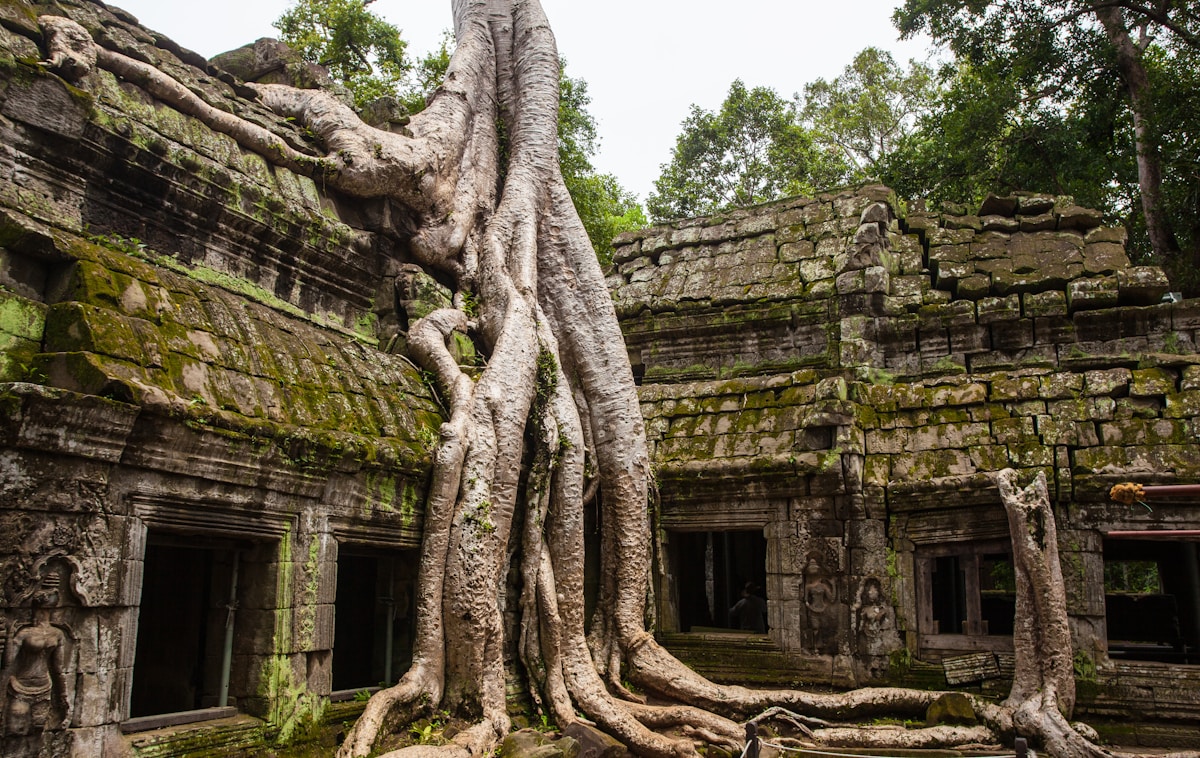
Cambodia’s Angkor Archaeological Park (day pass USD 37, 3 days USD 62) is the most extraordinary temple complex in Southeast Asia, and possibly the world. Angkor Wat itself - built in the early 12th century as a Hindu temple, later converted to Buddhism - covers 1.6 km² and has a 5-km circumference moat. The Bayon at Angkor Thom (with its famous face towers), Ta Prohm (roots of giant trees growing through the stone), and Banteay Srei (pink sandstone carvings) make 3 days the minimum justice. Hire a tuk-tuk driver in Siem Reap for approximately USD 15–25/day - guides add depth at around USD 30–40.
Thailand’s temples span a different historical tradition. Bangkok’s Grand Palace and Wat Phra Kaew (THB 500) is architecturally spectacular - the Emerald Buddha and gilded spires are extraordinary. Ayutthaya (80 km north of Bangkok, day trip THB 300–500 by minivan or train) has the ruined temples of Thailand’s former capital spread across a river island - a UNESCO World Heritage Site that absorbs a full day. Chiang Mai’s 300+ temples in the northern walled city represent centuries of Lanna kingdom architecture. Sukhothai (5–6 hours north of Bangkok) has perhaps the country’s most serene temple ruins. Thailand’s temples are widely distributed; Cambodia’s Angkor is uniquely concentrated.
Food
Thailand sets the standard for street food in Southeast Asia. Bangkok’s food scene - from Michelin-starred street vendors like Jay Fai to the extraordinary Yaowarat Chinatown night markets - is in a category of its own. Northern Thai cuisine (khao soi in Chiang Mai), Isaan food (papaya salad, grilled chicken in northeastern Thailand), and southern curries (massaman, yellow curry in Phuket) mean the food changes character as you travel the country.
Cambodia’s Khmer cuisine is deeply flavoured and underrated. Fish amok (fish curry steamed in banana leaves, approximately USD 5–8) is the national dish. Bai sach chrouk (pork and rice) is a breakfast staple at USD 1.50–2.50. Lok lak (stir-fried beef with lime sauce) at USD 5–7 is widely available and excellent. The food scene in Phnom Penh has improved dramatically - Romdeng and Malis are both excellent mid-range Khmer restaurants at USD 8–15 per main. Siem Reap’s restaurant scene caters heavily to tourists with predictable results.
Beaches
Thailand has two fully developed coastal regions. The Andaman coast (Phuket, Krabi, Koh Lanta, Koh Phi Phi) has the dramatic limestone scenery, clear water, and snorkelling infrastructure. The Gulf coast (Koh Samui, Koh Phangan, Koh Tao) adds diving and the Full Moon Party. Together, they offer more beach variety than any comparable area in Southeast Asia.
Cambodia’s beach development is centred around Sihanoukville (now heavily Chinese-developed and controversial in character), Kep (quiet, crab-focused), and the islands of Koh Rong and Koh Rong Samloem. The islands have genuinely beautiful beaches - white sand, clear water - but the infrastructure is still developing. Koh Rong Samloem in particular has a beautiful, low-key atmosphere for those who don’t mind limited electricity and basic accommodation.
History and Culture
Cambodia carries the weight of the Khmer Rouge genocide (1975–1979) - a period that killed an estimated 1.5–2 million people. The Tuol Sleng Genocide Museum in Phnom Penh (USD 8 entry) and the Killing Fields of Choeung Ek (USD 6, 15 km from the city) are among Southeast Asia’s most important and sobering experiences. Understanding this history is part of understanding Cambodia.
Thailand has a long, layered history - from the Sukhothai Kingdom (13th century) through Ayutthaya and the modern Chakri dynasty - but it avoided colonisation and major modern atrocities. Its history is more gradual and less dramatically weighted than Cambodia’s. The Bangkok National Museum and Ayutthaya’s ruined temples give historical depth, but Cambodia’s emotional weight is singular.
Costs and Practicalities
Thailand costs for budget travellers run THB 1,200–1,800 per day (USD 35–53). The transport infrastructure - domestic budget airlines from THB 600, overnight buses from THB 300, a working train system - makes getting around affordable. ATMs are everywhere. English is widely spoken in tourist areas.
Cambodia uses USD as its de facto currency alongside the riel. Budget travellers spend approximately USD 30–45 per day outside Angkor pass costs. Roads outside Siem Reap and Phnom Penh are poor by Thai standards. Tuk-tuks dominate city transport. The e-visa (USD 30) is straightforward online. English is widely spoken in tourist areas. Mobile data is cheap and fast.
Getting Around
Thailand has Bangkok’s MRT and BTS Skytrain, domestic budget airlines, an overnight train network, and well-developed minivan and bus services. Island ferries operate on fixed schedules with reliable operators. Getting between any two major Thai destinations is straightforward and affordable.
Cambodia is trickier. Siem Reap and Phnom Penh are connected by comfortable buses (USD 8–12, 6 hours) and domestic flights (USD 50–100, 45 minutes). The road south to Sihanoukville is improving. Within Siem Reap, tuk-tuks are the standard (USD 2–5 per trip, negotiate). There is no national rail network for tourists.
Verdict
Choose Thailand for your first Southeast Asia trip, a beach holiday, world-class street food, maximum variety, or an extended multi-week trip.
Choose Cambodia if Angkor Wat is on your bucket list (it should be), you want to understand Cambodia’s extraordinary and tragic modern history, or you are doing a Southeast Asia multi-country loop that naturally passes through.
The best Southeast Asia trip includes both. Fly or bus from Bangkok to Siem Reap, spend 3–4 days on Angkor, continue to Phnom Penh, then fly back to Bangkok or connect onwards. This gives you Thailand’s range and Cambodia’s singular depth in a single 3–4 week trip.
For context see our getting around Thailand guide and Bangkok city guide for planning the Thai leg. See also: Thailand vs Vietnam · Thailand vs Bali · Two weeks in Thailand itinerary · Visa guide for Thailand
Browse tours and experiences across Thailand to plan the Thai side of your trip - Bangkok day trips, Chiang Mai activities, and island excursions.
Plan Your Trip
If Thailand is the destination, our two weeks in Thailand itinerary maps a route covering Bangkok, Chiang Mai, and the south in a logical sequence. Our visa guide covers entry requirements for Thailand, and the getting around Thailand guide handles overland transport if you’re crossing between the two countries.
Book Your Trip
- Flights - Find the best fares to Thailand
- Travel Insurance - Get covered before you go
- eSIM - Stay connected from landing
- Car Rental - Compare prices across providers
See also: 1-week Thailand itinerary · Getting around Thailand · Best time to visit Thailand