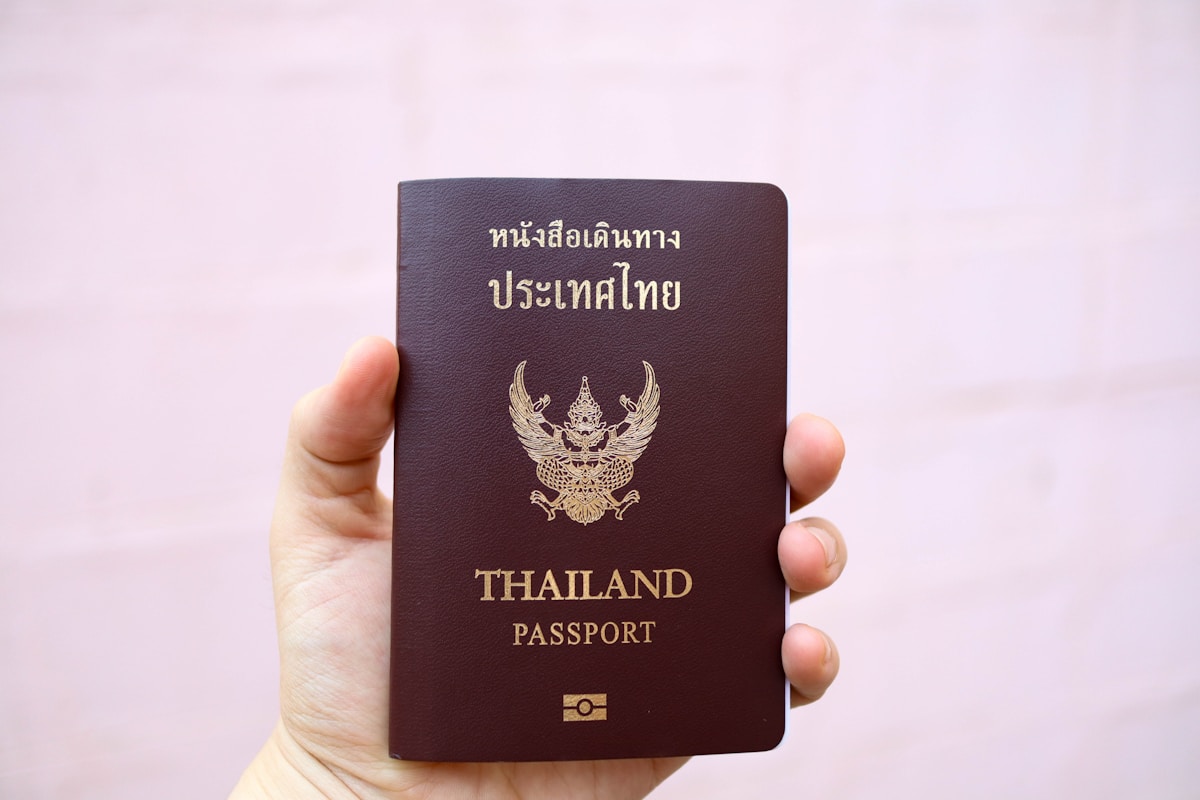
Before you travel:
- Travel insurance — EKTA covers medical emergencies, trip cancellation, and travel delays. Sort it before you board.
- eSIM — buy a Thailand eSIM so you have data from the moment you clear customs.
- Flights — Compare fares to Thailand to lock in your dates.
Visa exemption (most common option)
As of 2024, Thailand grants 60-day visa-free entry to citizens of most Western countries arriving by air. Countries included: United Kingdom, United States, European Union members, Australia, Canada, New Zealand, Japan, South Korea, and around 60 others.
Conditions:
- Entry must be by air (land crossings still receive 30 days)
- You must hold a return or onward ticket (rarely enforced but required in principle)
- Your passport must be valid for at least 6 months from entry date
- Immigration officers may ask for proof of sufficient funds (฿20,000 per person or ฿40,000 per family - again rarely enforced at major airports)
Check the Royal Thai Embassy website for your country’s specific allowance - exemption lengths vary.
Tourist visa (TR)
If you need more than 60 days, a Tourist Visa (TR) issued before travel gives 60 days entry with an optional 30-day extension, totalling 90 days. Single-entry tourist visas cost varies by country (typically $30–50 USD equivalent). Multi-entry tourist visas (METV) give 6 months validity with 60-day stays per entry.
Apply at the Thai embassy or consulate in your home country, or in a neighbouring country (common for those already in Southeast Asia).
Visa extension at immigration offices
A single extension of up to 30 days is available at any Thai Immigration Office:
- Cost: ฿1,900
- Documents: passport, TM.7 form (available on-site), one passport photo, a copy of your passport photo page and current entry stamp
- Processing time: 30–90 minutes at busy offices
Major immigration offices:
- Bangkok: Government Complex, Chaeng Watthana Road (open Mon–Fri 8:30am–4:30pm)
- Chiang Mai: Airport Road (Mahidon Road), Mueang district
- Phuket: Phuket Town, Phuket Road
Departure and re-entry
Leaving Thailand and re-entering resets your visa allowance. This is called a “border run” - common among longer-term visitors. With the 60-day exemption, you leave to a neighbouring country (Malaysia, Laos, Cambodia, Myanmar) for any period and re-enter for another 60 days.
Note: Immigration officers have discretion to refuse entry to travellers they believe are living in Thailand on tourist visas long-term. Multiple back-to-back border runs (5+ entries per year) can trigger scrutiny.
Long-Term Resident (LTR) Visa
The LTR Visa was launched in 2022 as a formal long-stay option for qualified individuals:
Categories:
- Wealthy Pensioner - 50+ years old, $40,000/year income or $250,000 assets
- Work From Thailand Professional - Remote workers employed by overseas companies, earning $80,000+ annually
- Wealthy Global Citizen - $1 million+ investable assets, $80,000+ income in last 2 years
- Highly Skilled Professional - Working in specified technical fields in Thailand
Benefits: 10-year stay (5+5 renewable), work permit for remote workers, 17% flat income tax rate on Thai-sourced employment, exemption on foreign-sourced income.
Apply via the Thailand Board of Investment (BOI) website. Application costs approximately $500 USD and requires income/asset documentation.
Thailand Digital Nomad Visa (DTV)
Introduced in 2024, the Destination Thailand Visa (DTV) allows remote workers and freelancers to stay for 180 days per entry on a 5-year multi-entry visa.
Cost: ฿10,000 (approximately $300 USD). Apply at a Thai embassy or through the consular e-visa system. Requires proof of remote work, $27,000 in funds or equivalent income, and valid health insurance. Compare Thailand travel insurance options that satisfy this requirement.
Retirement visa (Non-Immigrant O-A)
For those 50+. Requires either ฿800,000 in a Thai bank account (maintained throughout the visa period) or monthly income of ฿65,000+. Issued for 1 year, renewable. Health insurance covering ฿40,000 outpatient and ฿4 million inpatient is required. Compare Thailand travel insurance options that satisfy this requirement.
Practical tips
- Planning a solo trip? Our Thailand solo travel guide covers the best bases, safety, and how to make the most of travelling independently
- Set up connectivity before you arrive - buy a Thailand eSIM to have data from the moment you clear immigration
- Always enter with at least 6 months validity on your passport - Thai immigration enforces this
- Keep a copy of your entry stamp and departure card (TM.6) - you’ll need it at immigration extensions
- For longer stays, consult a licensed Thai immigration lawyer or visa agent - the rules change frequently and the BOI publishes updated guidance
See also: Health and vaccinations for Thailand · Travel insurance for Thailand · Basic Thai phrases · Digital nomad guide to Thailand · Flights to Thailand · Getting around Thailand · Budget guide to Thailand
Plan Your Trip
Once your entry is sorted, see our getting around Thailand guide for the full transport picture — airport links, trains, buses, and ferries. Our Bangkok city guide covers the first few days in the capital, and the two weeks in Thailand itinerary maps a wider route if you’re planning a multi-stop trip.
Book Your Trip
- Flights - Find the best fares to Thailand
- Travel Insurance - Get covered before you go
- eSIM - Stay connected from landing
- Car Rental - Compare prices across providers
See also: Flights to Thailand · Getting around Thailand · 1-week Thailand itinerary
Travel Insurance
Travel insurance is worth sorting at the same time as your visa — it covers medical treatment, emergency evacuation, and trip cancellation if your plans change before departure. We recommend EKTA for straightforward policies that cover most nationalities travelling to Thailand. A quote takes under five minutes and single-trip cover typically starts from around $30 for a two-week stay.