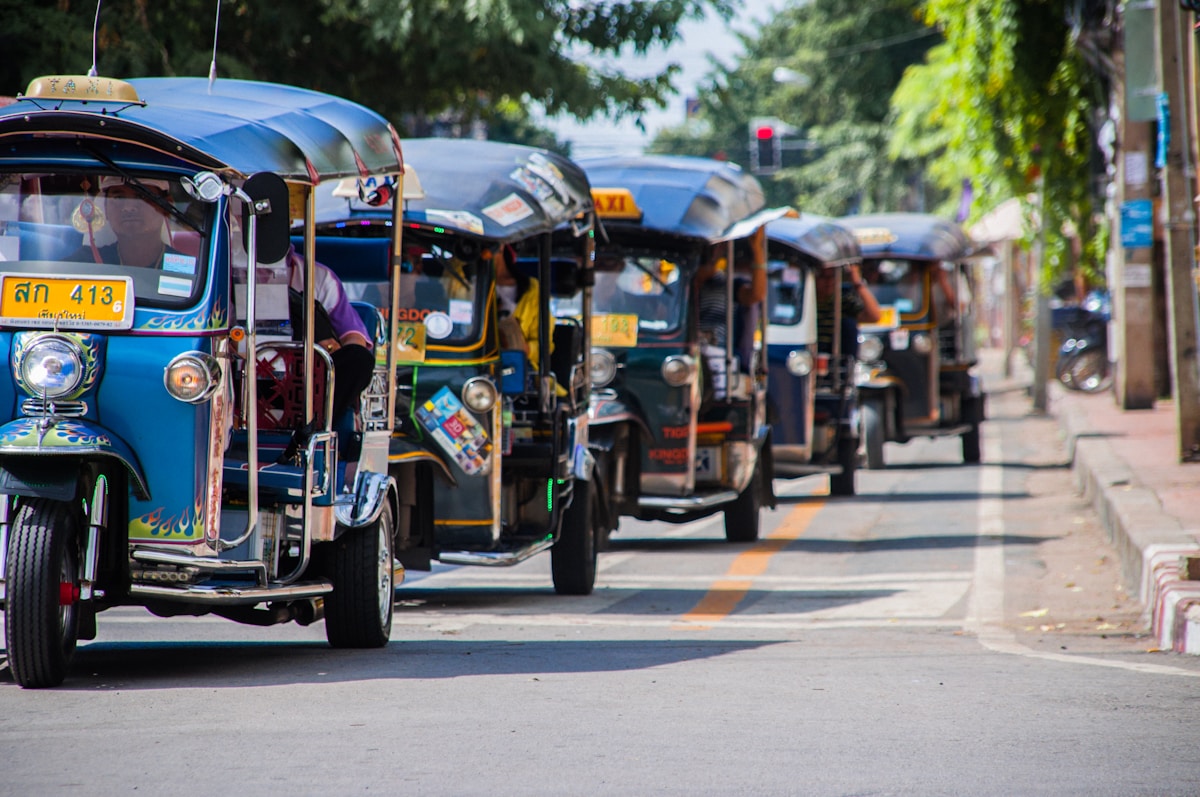
Bangkok transport
BTS Skytrain and MRT Metro
Bangkok’s two rail networks cover the central and expanded city. The BTS (above-ground) connects most tourist and business areas: Sukhumvit, Silom, Chatuchak, On Nut. The MRT (underground) loops through Hua Lamphong, Chatuchak, Silom/Lumphini, and now extends to the outer suburbs.
A Rabbit Card (BTS) or stored-value MRT card makes journeys faster than buying single tickets. Cards are available at all stations - tourists now need passport registration to buy one in person. Single fares: ฿17–62 depending on distance.
The rail network does not reach the Grand Palace, Wat Pho, or Khao San Road - these require a ferry, tuk-tuk, or Grab.
Chao Phraya River Ferry
A practical commuter option for riverside destinations. The Express Boat (orange and yellow flag boats) runs from Nonthaburi in the north to Rat Burana in the south, stopping at major piers including Saphan Taksin (BTS connection), Tha Chang (Grand Palace), Tha Tien (Wat Pho/Wat Arun ferry), and Tha Phra Athit (Khao San Road area). Fare: ฿10–32. A day pass (฿150) covers unlimited orange-flag boat rides.
Grab vs metered taxis
Grab gives a fixed price and traceable driver - highly recommended over standard taxis, which sometimes refuse to use the meter in tourist areas. If using a metered taxi, insist on the meter before getting in. Starting rate: ฿35 flag-fall + ฿2–5 per km. Expressway tolls are additional.
Airport Rail Link
Connects Suvarnabhumi Airport to Makkasan (City Air Terminal) and Phaya Thai BTS station in 30 minutes. Fare: ฿45. Runs 6am–midnight. Significantly faster and cheaper than taxi for the city centre. For a door-to-door option, Welcome Pickups offers pre-booked private transfers from Suvarnabhumi and Don Mueang with a fixed price and named driver.
Intercity transport
Trains
The State Railway of Thailand (SRT) operates an extensive network covering most major destinations. Sleeper trains are the highlight - the Bangkok–Chiang Mai overnight train runs daily, with first-class air-con sleepers (฿1,300–1,600), second-class sleepers (฿700–900), and seated second class (฿300–600).
Key routes and journey times:
- Bangkok → Chiang Mai: 11–13 hours (overnight, departs Hua Lamphong ~18:00)
- Bangkok → Ayutthaya: 1.5 hours (frequent daily trains)
- Bangkok → Kanchanaburi: 3.5 hours (departs Thonburi station)
- Bangkok → Surat Thani: 8–10 hours (overnight options available for Koh Samui ferry connection)
Book at Hua Lamphong station or the SRT online booking portal (dticket.railway.co.th). Peak season (December–February, Songkran) books up fast for sleeper berths. Compare train and bus prices on Omio if you want to check availability across both modes before booking.
Buses
Government and private buses connect every destination in Thailand at lower prices than trains and flights. The main terminals in Bangkok are Mo Chit (Chatuchak area, for northern and northeastern routes) and Sai Tai Mai (southern bus terminal, for Kanchanaburi and southern routes).
Private minivans (rot doo) are faster for shorter routes - Bangkok to Hua Hin (3.5 hours, ฿200), Bangkok to Kanchanaburi (2 hours, ฿120), Chiang Mai to Pai (3 hours, ฿150). Depart frequently from their own terminals rather than the main bus stations.
Domestic flights
Thai AirAsia, Thai Lion Air, Nok Air, Bangkok Airways, and Thai Airways connect major cities. Bangkok has two airports: Suvarnabhumi (international + some domestic) and Don Mueang (primarily low-cost domestic and budget international).
Useful routes and approximate prices:
- Bangkok → Chiang Mai: 1h20m, from ฿800
- Bangkok → Phuket: 1h20m, from ฿900
- Bangkok → Koh Samui: 1h15m (Bangkok Airways only), from ฿2,500
- Bangkok → Krabi: 1h20m, from ฿900
Don Mueang serves AirAsia and Nok Air. Suvarnabhumi serves Bangkok Airways (which has a monopoly on Koh Samui routes and prices accordingly). Check both airports when searching. Search domestic flights on Aviasales to compare fares across all carriers.
Getting to islands
Ferries and speedboats
All Thai islands are reached by boat. Main connections:
- Phuket → Koh Phi Phi: 45 minutes speedboat or 2 hours ferry. Rassada Pier.
- Surat Thani → Koh Samui: 1.5 hours (Raja Ferry). Alternatively, Donsak pier.
- Koh Samui → Koh Phangan: 30 minutes, multiple daily, ฿200.
- Koh Phangan → Koh Tao: 1 hour, ฿250.
- Krabi/Ao Nang → Koh Lanta: 1.5–2 hours by speedboat, ฿350–450.
High-season ferry routes run multiple times daily. In low season, some speedboat services reduce to once daily or stop entirely - always confirm before travelling.
Lomprayah and Songserm are the main high-speed catamaran operators; Raja Ferry and Seatran run slower car ferries that also take vehicles.
Local transport
Songthaews
Pickup trucks with covered beds and bench seats. Fixed routes in Chiang Mai, Phuket, Koh Samui, and most provincial cities. Fares: ฿20–50 for standard routes. Hail from the roadside; tell the driver your destination before getting in. No fixed stops - ask to be dropped where you need.
Tuk-tuks
Found in Bangkok, Chiang Mai, Ayutthaya, and tourist areas. Always negotiate the price before getting in. A fair rate in Bangkok: ฿60–100 for short distances. Tuk-tuks are slower than Grab for most journeys and primarily serve as a tourist experience.
Scooter rental
Standard practice for exploring islands and smaller towns. Costs ฿150–300/day. An international driving licence (motorcycle endorsed) is technically required and occasionally checked. In practice, rental shops in tourist areas rarely ask. However, accidents on scooters are the single largest cause of tourist injury in Thailand - drive defensively, wear a helmet, and don’t attempt roads you’re not comfortable with. Koh Tao and Koh Phangan have particularly steep, narrow roads that catch out inexperienced riders.
Plan Your Trip
- Flights - Find the best fares to Thailand
- Travel Insurance - Get covered before you go
- eSIM - Stay connected from landing
- Car Rental - Compare prices across providers
See also: Scooter rental in Thailand · Bangkok to Koh Samui routes · Bangkok to Chiang Mai · SIM cards in Thailand · Flights to Thailand · Budget guide to Thailand · Visa guide for Thailand