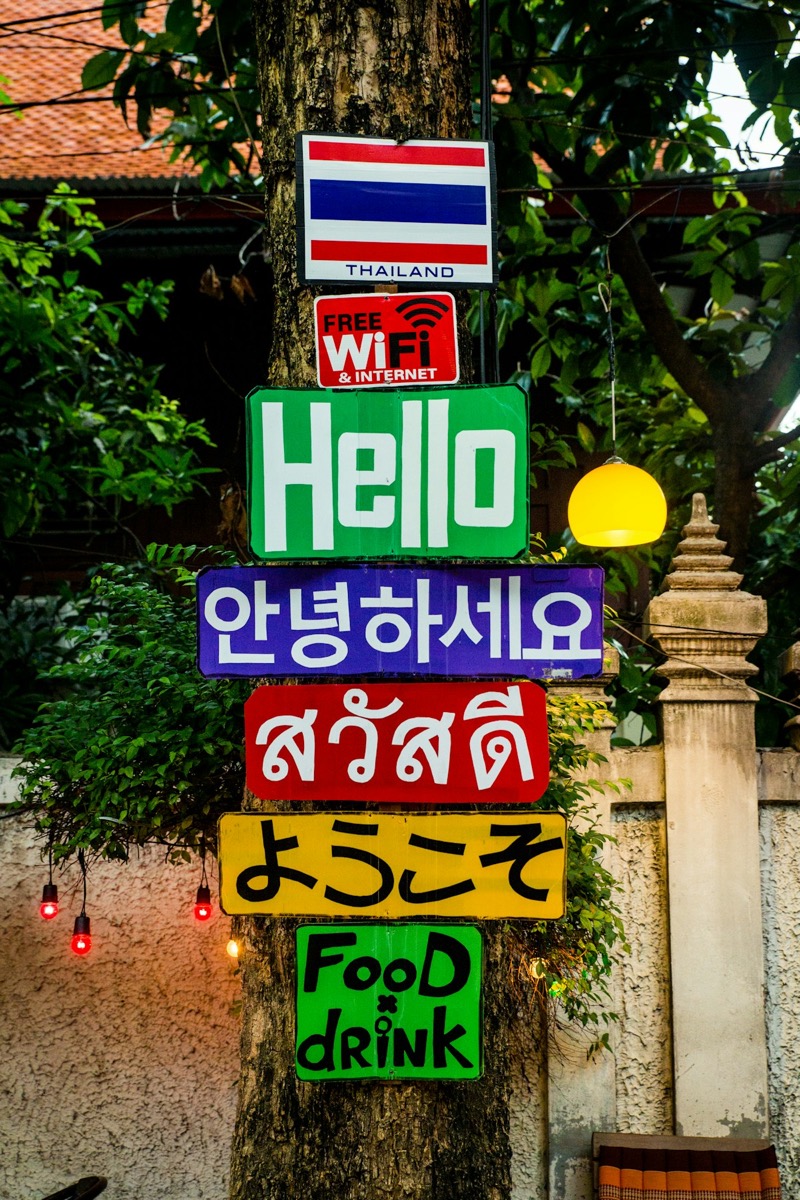
Thai is a tonal language with five tones - mid, low, falling, high and rising - meaning the same syllable can have completely different meanings depending on pitch. While this makes perfect pronunciation challenging, Thai people are accustomed to foreign attempts and will work to understand you through context. One unique feature of Thai is the politeness particle: men end sentences with “krap” and women with “ka.” Adding this particle to any phrase instantly makes it more polite.
Greetings and Basics
| English | Thai | Pronunciation |
|---|---|---|
| Hello | สวัสดี | sa-wat-DEE (+ krap/ka) |
| Goodbye | ลาก่อน | la-GORN |
| Please | กรุณา | ga-ru-NAH |
| Thank you | ขอบคุณ | khop-KHUN (+ krap/ka) |
| Yes | ใช่ | CHAI |
| No | ไม่ | MAI |
| Excuse me | ขอโทษ | khor-TOHT |
| Sorry | ขอโทษ | khor-TOHT |
| How are you? | สบายดีไหม | sa-bai dee MAI |
| I’m fine | สบายดี | sa-bai DEE |
Getting Around
| English | Thai | Pronunciation |
|---|---|---|
| Where is…? | …อยู่ที่ไหน | yoo tee-NAI |
| How much? | เท่าไร | tao-RAI |
| Left | ซ้าย | SAI |
| Right | ขวา | KWAH |
| Stop here | จอดที่นี่ | jort tee-NEE |
| Taxi | แท็กซี่ | TAEK-see |
| Bus station | สถานีรถบัส | sa-ta-nee rot BAS |
| Airport | สนามบิน | sa-nahm BIN |
| I don’t understand | ไม่เข้าใจ | mai khao JAI |
| Too expensive | แพงไป | paeng PAI |
Food and Dining
| English | Thai | Pronunciation |
|---|---|---|
| The menu, please | ขอเมนูหน่อย | khor me-nu NOY |
| The bill, please | เก็บเงินด้วย | gep ngern DUAY |
| Water | น้ำ | NAHM |
| Delicious | อร่อย | a-ROY |
| Not spicy | ไม่เผ็ด | mai PET |
| I am vegetarian | กินเจ | gin JAY |
| Rice | ข้าว | KHAO |
| Beer | เบียร์ | BIA |
| Coffee | กาแฟ | ga-FAE |
| Cheers! | ไชโย! | chai-YO |
Numbers
| Number | Thai | Pronunciation |
|---|---|---|
| 1 | หนึ่ง | NEUNG |
| 2 | สอง | SORNG |
| 3 | สาม | SAHM |
| 4 | สี่ | SEE |
| 5 | ห้า | HAH |
| 6 | หก | HOK |
| 7 | เจ็ด | JET |
| 8 | แปด | BPAET |
| 9 | เก้า | GAO |
| 10 | สิบ | SIP |
Before travelling, two practical essentials: an eSIM for Thailand means you have data on arrival without needing to find a SIM card at the airport, and travel insurance for Thailand covers the medical costs if the emergency phrases below ever become relevant.
Emergency Phrases
| English | Thai | Pronunciation |
|---|---|---|
| Help! | ช่วยด้วย! | CHUAY duay |
| Hospital | โรงพยาบาล | rohng pa-ya-BAHN |
| Police | ตำรวจ | tam-RUAT |
| I need a doctor | ต้องการหมอ | dtorng-gahn MOR |
| Call an ambulance | เรียกรถพยาบาล | riak rot pa-ya-BAHN |
The most practical pronunciation tip for Thai is to focus on getting the polite particles right: end every sentence with “krap” (men) or “ka” (women). This single habit will earn you more goodwill than perfect tones. When bargaining at markets, knowing numbers and “paeng pai” (too expensive) is worth more than a phrasebook full of formal vocabulary. One final tip: Thai people often use “mai pen rai” (never mind / no worries) as a response to thank you or apologies - if you hear it, it means all is well.
For broader trip preparation, our getting around Thailand guide covers transport vocabulary in context, and the visa guide explains entry requirements before you arrive.
Plan Your Trip
With a few key phrases in your toolkit, the pre-trip checklist is nearly complete — the visa guide and health and vaccinations guide cover the remaining entry requirements. For your first week on the ground, the 1 week Thailand itinerary puts Bangkok, Chiang Mai, and the islands in sequence with transport notes between each stop. The packing list includes a phrasebook recommendation for travellers who want to go beyond the basics.
Book Your Trip
- Flights - Find the best fares to Thailand
- Travel Insurance - Get covered before you go
- eSIM - Stay connected from landing
- Car Rental - Compare prices across providers
See also: 1-week Thailand itinerary · Bangkok city guide · Getting around Thailand