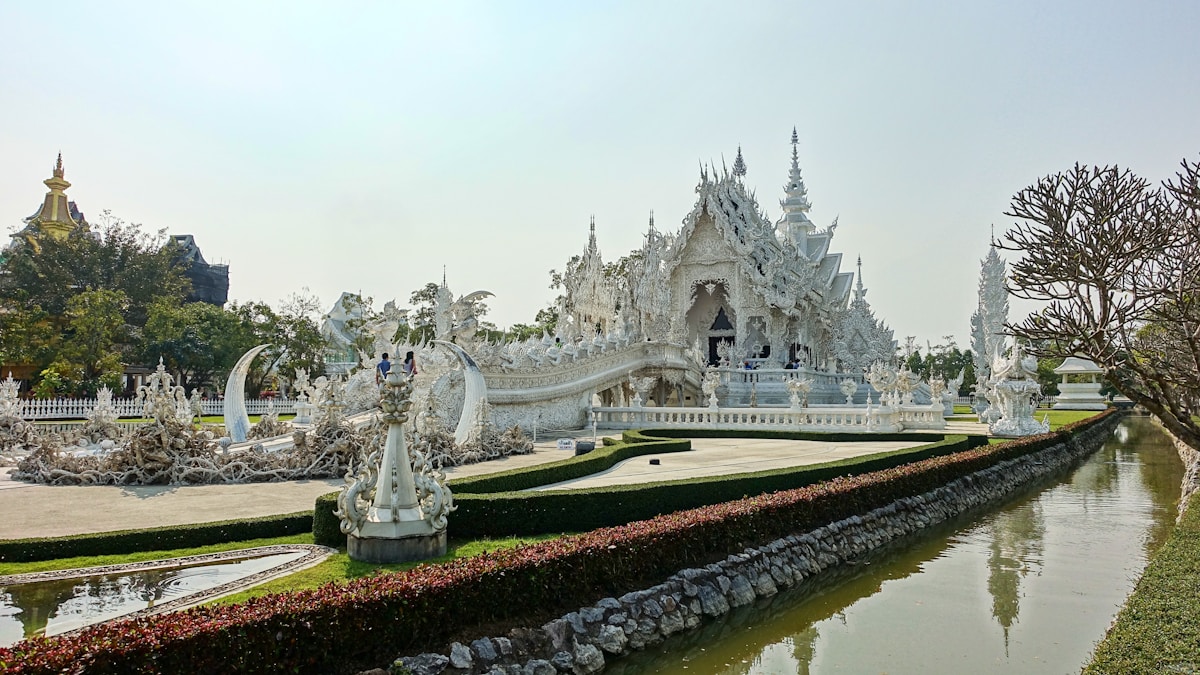
Chiang Rai is a smaller, quieter city than Chiang Mai, but its trio of distinctive temples - the White Temple, the Blue Temple, and the Black House - make it one of the most visually remarkable single-day destinations in northern Thailand. All three are modern or contemporary works rather than ancient ruins, which makes Chiang Rai unusual: this is contemporary Thai art and architecture at its most ambitious.
From Chiang Mai, the city is 200 km north - a 3-hour drive or a 30-minute flight - and best visited as a day trip unless you want to continue into the Golden Triangle region or cross into Laos or Myanmar.
Top Tours at a Glance
Here’s a quick comparison of top-rated tours on GetYourGuide:
| Tour | Duration | Price (from) | Group Size | Highlights |
|---|---|---|---|---|
| Chiang Rai White Temple, Blue Temple & Black House Day Trip | 12 hrs | from $38/person | Group (max 14) | All three major Chiang Rai sites, English guide |
| White Temple & Golden Triangle Full-Day Tour | 13 hrs | from $55/person | Group (max 12) | Wat Rong Khun, Don Sao boat trip, three-country viewpoint |
| Private Chiang Rai Day Tour from Chiang Mai | 12 hrs | from $70/person | Private (2–6) | Custom routing, all entry fees, flexible pace |
| Chiang Rai Temples Half-Day Tour from Chiang Rai | 4 hrs | from $30/person | Group (max 10) | White Temple, Blue Temple, local transport |
Browse all Chiang Rai day tours → GetYourGuide
Getting there from Chiang Mai
Guided tour - The most efficient option for seeing all three main sites in a day. Tours depart Chiang Mai early (typically 6:00–7:00) and return by 19:00–20:00. A standard day tour includes the White Temple (Wat Rong Khun), the Blue Temple (Wat Rong Suea Ten), and Baan Dam (the Black House). Some tours also include the Golden Triangle viewpoint or a visit to the Chiang Rai night market. Cost: approximately THB 1,200–2,000 per person as of 2026 with transport and guide, not always including entry fees. Browse Chiang Rai day tours from Chiang Mai to compare options.
Public bus - Buses from Chiang Mai’s Arcade Bus Terminal (Green Bus terminal) run regularly throughout the day. Air-conditioned coaches take approximately 3 hours and cost approximately THB 130–200 one way. The Chiang Rai bus terminal is about 5 km from the White Temple. From the terminal, a tuk-tuk or red songthaew to Wat Rong Khun costs approximately THB 50–80.
Private driver or hire car - A private driver from Chiang Mai for the day runs approximately THB 2,500–4,000 for the vehicle. The most flexible option for families or small groups, allowing custom routing and timing. Compare car hire in Thailand if you prefer driving yourself.
Wat Rong Khun - the White Temple
This is the main draw and nothing like any temple you’ve seen before. Artist and architect Chalermchai Kositpipat began construction in 1997 using his own funds, with the stated intention of creating a temple so beautiful that it could not be replicated. He is still building.
The approach crosses a bridge flanked by hundreds of white hands reaching upward - representing souls in hell. The bridge itself is the transition from the cycle of rebirth to nirvana. The main ubosot (ordination hall) is built entirely from white plaster embedded with millions of mirrored glass pieces that shimmer in sunlight. Inside, Kositpipat has painted contemporary murals including popular culture references - Superman, Pikachu, the World Trade Center - alongside traditional Buddhist imagery, framing them as representations of material desire and delusion. Photography inside is prohibited.
The grounds include additional buildings still under construction, a golden building housing toilets (an intentional contrast - gold represents material wealth and belongs with excretion, while white represents purity), and a gallery of Kositpipat’s earlier work.
Entry: approximately THB 100 as of 2026. Allow 1–1.5 hours. The temple is busiest 10:00–14:00. Arriving at opening (usually 6:30 or 8:00 depending on the day - check the official site) gives better light for photography and fewer crowds.
Wat Rong Suea Ten - the Blue Temple
About 4 km from Wat Rong Khun, the Blue Temple is a newer reconstruction that replaced a smaller chapel on the same site. The exterior is painted royal blue and gold; the interior houses an enormous blue-tinted plaster Buddha beneath a ceiling painted in intricate patterns. The deep jewel-tone colours make this the most photogenic interior in Chiang Rai.
Entry is free as of 2026, though a donation box is at the entrance. The temple is active - monks and worshippers are present - so maintain respectful behaviour. The light inside is best in the morning. Allow 30–45 minutes.
Baan Dam - the Black House
Approximately 5 km north of Chiang Rai town centre, Baan Dam (Black House) is the lifetime project of Thai artist Thawan Duchanee - a complex of 40 black timber buildings filled with animal skulls, stretched hides, carved dark wood, and bones. The effect is deliberately gothic and masculine, a counterpoint to the White Temple’s purity. Not a Buddhist temple but a profound artistic statement about death and nature. Photography throughout is encouraged.
Entry: approximately THB 80 as of 2026. Allow 45–60 minutes. The Black House is often omitted from basic day tours - confirm it is included before booking if you want to see it.
The Golden Triangle (optional add-on)
Most day tour operators offer a Golden Triangle extension - the point where Thailand, Laos, and Myanmar meet at the confluence of the Mekong and Ruak rivers, about 60 km north of Chiang Rai. The viewpoint itself is modest; the area has a museum about the opium trade (Hall of Opium, entry approximately THB 200) and a short boat trip to the river confluence (approximately THB 100). Worth adding if you have the time; not essential if the temples are your priority.
What to wear
All three main sites require modest dress (shoulders and knees covered). The White Temple provides sarongs for free borrowing at the gate. Bring sun protection - the Chiang Rai area is sunny and hot in the dry season, and the approach to the White Temple is fully exposed.
Chiang Rai Tours at a Glance
Prices are approximate as of 2026. Book via GetYourGuide for free cancellation.
| Tour | Duration | Price (approx.) | Group size | What’s included |
|---|---|---|---|---|
| Chiang Rai White Temple + Blue Temple day tour | 8–9 hrs | from $30 | Group (up to 12) | Transport from Chiang Mai, guide, both temples |
| Chiang Mai to Chiang Rai temples + Golden Triangle | 9–10 hrs | from $45 | Group | Transport, guide, White Temple, Black House, river boat |
| Private Chiang Rai full-day tour | 9 hrs | from $120/vehicle | Private (up to 4) | Driver-guide, hotel pickup, custom stops |
| White Temple + Doi Tung + Golden Triangle | 10 hrs | from $55 | Small group | Transport, guide, all 3 sites |
| Chiang Rai 2-day tour with overnight | 2 days | from $150/person | Small group | Hotel, transport, guided circuit |
Staying in Chiang Rai
If you want to go beyond a day trip, Chiang Rai is worth an overnight. The city is calmer and less touristy than Chiang Mai, with a good Saturday Walking Street market and easy access into the Golden Triangle and Doi Tung area. See our Chiang Rai travel guide and Chiang Rai things to do guide for full details.
See also: Chiang Mai travel guide · Chiang Mai day trips · One week in northern Thailand