
Thai - ภาษาไทย (phasa thai, literally “Thai language”) - is spoken by approximately 70 million people and has been the official language of Thailand since the Sukhothai Kingdom of the 13th century. It belongs to the Tai-Kadai language family, which also includes Lao and Zhuang. For travellers, two features define the language immediately: it has its own script unlike any other in Asia, and it is tonal - meaning the pitch at which you say a word changes its meaning entirely. With preparation, both of these features are manageable.
The Thai Language and Script
Thai script (อักษรไทย, akson thai) was developed in 1283 under King Ramkhamhaeng of Sukhothai. It descends from Old Khmer, which itself derived from the Brahmic scripts of southern India - the same root as Burmese, Lao, and many Southeast Asian writing systems. The script has 44 consonants, 15 basic vowel symbols that combine to produce 28 vowel forms, 4 tone marks, and 10 numerical digits (although Thai Thai numerals are understood alongside Arabic numerals in most contexts).
Unlike English, Thai script is written from left to right with no spaces between words - sentence breaks are indicated by spaces rather than full stops. Vowels can appear above, below, before, or after the consonant they modify, which is one reason the script looks complex on first encounter. In practice, tourist-facing signs, menus, and transport displays in Bangkok, Chiang Mai, Phuket, Krabi, and Koh Samui almost always include English transliteration alongside the Thai.
Consonants are grouped into three classes - low, mid, and high - and the class of the consonant in a syllable determines how tone marks are applied. This consonant-class system is the core structural feature that non-native speakers find most challenging, but for travel purposes it is enough to recognise that the same tone mark can produce different tones depending on which consonant precedes it.
Pronunciation Guide
 Ruined brick temple with a Buddha statue, Ayutthaya.
Thai has five tones. Getting them precisely right takes time, but learning which direction a tone moves (up, down, flat) is enough for most travel communication.
| Tone | Description | Key Indicator | Example |
|---|---|---|---|
| Mid | Flat, neutral pitch | No mark on a mid-class consonant | mai (wood) |
| Low | Slightly lower than mid | ่ mai ek mark | mài (not/no) |
| Falling | Starts high, drops sharply | ้ mai tho mark | mâi (silk) |
| High | Starts above mid, falls slightly at end | ๊ mai tri mark | mái (mile) |
| Rising | Starts low, dips then rises | ๋ mai jattawa mark | mǎi (to burn) |
The classic example of tone importance: the word mai (มาย/ไม้) said with different tones can mean wood, not, silk, to burn, or new - five completely different meanings from identical sounds. Context saves most conversations, but the tones are worth practising.
Key pronunciation rules for English speakers:
- kh = heavily aspirated k, like “k” with a sharp puff of air - never like “ch”
- ph = aspirated p sound - NOT like English “f”; think the “p” in “pot” with extra breath
- th = aspirated t - NOT like English “th” in “the”; it’s a strong “t”
- ng at the start of a word is common and has no English equivalent - like the “ng” at the end of “sing” but at the beginning
- r is often pronounced as “l” in casual everyday speech (e.g. rot becomes lot)
- dt and bp are unaspirated versions of t and p - softer than their aspirated counterparts
- Vowel length matters: short vowels (kao) and long vowels (khaao) carry different meanings
The safest shortcut for travellers: add “krap” (men) or “ka” (women) to the end of every sentence. This politeness particle alone signals respect regardless of how imperfect your tones are.
Essential Phrases
Greetings and Basics
| English | Thai | Pronunciation |
|---|---|---|
| Hello / Good day | สวัสดี | sa-wat-DEE (+ krap/ka) |
| Goodbye | ลาก่อน | la-GORN |
| Thank you | ขอบคุณ | khop-KHUN (+ krap/ka) |
| You’re welcome | ไม่เป็นไร | mai pen RAI |
| Sorry / Excuse me | ขอโทษ | khor-TOHT |
| Yes | ใช่ | CHAI |
| No | ไม่ใช่ | mai CHAI |
| Please | กรุณา | ga-ru-NAH |
| How are you? | สบายดีไหม | sa-bai dee MAI |
| I’m fine | สบายดี | sa-bai DEE |
| I don’t understand | ไม่เข้าใจ | mai khao JAI |
| Can you speak English? | พูดภาษาอังกฤษได้ไหม | poot pasa ang-GRIT dai MAI |
Transport and Getting Around
| English | Thai | Pronunciation |
|---|---|---|
| Where is…? | …อยู่ที่ไหน | yoo tee-NAI |
| How much does it cost? | เท่าไร | tao-RAI |
| Too expensive | แพงไป | paeng PAI |
| Turn left | เลี้ยวซ้าย | liao SAI |
| Turn right | เลี้ยวขวา | liao KWAH |
| Go straight | ตรงไป | trong PAI |
| Stop here | จอดที่นี่ | jort tee-NEE |
| I want to go to… | ผม/ฉัน ต้องการไป… | pom/chan dtorng-gan bpai… |
| Airport | สนามบิน | sa-nahm BIN |
| Train station | สถานีรถไฟ | sa-ta-nee rot FAI |
| Bus station | สถานีรถบัส | sa-ta-nee rot BAS |
| How long does it take? | ใช้เวลานานเท่าไร | chai we-la nahn tao-RAI |
Accommodation
| English | Thai | Pronunciation |
|---|---|---|
| Do you have a room? | มีห้องว่างไหม | mee horng wahng MAI |
| How much per night? | คืนละเท่าไร | keun la tao-RAI |
| I have a reservation | ผม/ฉัน จองไว้ | pom/chan jorng WAI |
| Can I see the room? | ขอดูห้องได้ไหม | khor doo horng dai MAI |
| Air conditioning | เครื่องปรับอากาศ | kreuang bprap ah-GAHT |
| Check out | เช็คเอ้าท์ | CHEK-out |
Food and Dining
| English | Thai | Pronunciation |
|---|---|---|
| The menu, please | ขอเมนูหน่อย | khor me-nu NOY |
| What do you recommend? | แนะนำอะไรบ้าง | nae-nam a-rai BAHNG |
| The bill, please | เก็บเงินด้วย | gep ngern DUAY |
| Delicious | อร่อย | a-ROY |
| Not spicy | ไม่เผ็ด | mai PET |
| A little spicy | เผ็ดนิดหน่อย | pet nit-NOY |
| Very spicy | เผ็ดมาก | pet MAHK |
| No meat | ไม่ใส่เนื้อ | mai sai NEUA |
| I am vegetarian | กินเจ | gin JAY |
| Water | น้ำเปล่า | nahm BPLAO |
Shopping and Bargaining
| English | Thai | Pronunciation |
|---|---|---|
| How much is this? | อันนี้เท่าไร | an-nee tao-RAI |
| Can you reduce the price? | ลดราคาได้ไหม | lot ra-kha dai MAI |
| I’ll take it | เอาอันนี้ | ao an-NEE |
| Do you have another colour? | มีสีอื่นไหม | mee see euun MAI |
| Where is the market? | ตลาดอยู่ที่ไหน | ta-laht yoo tee-NAI |
Emergencies
| English | Thai | Pronunciation |
|---|---|---|
| Help! | ช่วยด้วย! | CHUAY duay |
| Call the police | เรียกตำรวจ | riak tam-RUAT |
| I need a doctor | ต้องการหมอ | dtorng-gan MOR |
| Hospital | โรงพยาบาล | rohng pa-ya-BAHN |
| Call an ambulance | เรียกรถพยาบาล | riak rot pa-ya-BAHN |
| I am lost | ฉันหลงทาง | chan long TAHNG |
Before travelling, two practical essentials: an eSIM for Thailand gives you data from the moment you land without queuing at an airport kiosk, and travel insurance covers the medical costs if the emergency phrases above ever become necessary.
Numbers
| Number | Thai | Thai Script | Pronunciation |
|---|---|---|---|
| 0 | ศูนย์ | ๐ | SOON |
| 1 | หนึ่ง | ๑ | NEUNG |
| 2 | สอง | ๒ | SORNG |
| 3 | สาม | ๓ | SAHM |
| 4 | สี่ | ๔ | SEE |
| 5 | ห้า | ๕ | HAH |
| 6 | หก | ๖ | HOK |
| 7 | เจ็ด | ๗ | JET |
| 8 | แปด | ๘ | BPAET |
| 9 | เก้า | ๙ | GAO |
| 10 | สิบ | ๑๐ | SIP |
| 20 | ยี่สิบ | ๒๐ | yee-SIP |
| 100 | ร้อย | ๑๐๐ | ROY |
| 1,000 | พัน | ๑,๐๐๐ | PAN |
For prices at markets and bargaining, knowing numbers up to 1,000 covers almost every daily transaction. Thai prices are typically quoted in baht: “roi baht” (100 baht), “sorng roi baht” (200 baht).
Language Etiquette
Thai culture places an unusually high value on maintaining a calm, pleasant atmosphere - what is often called “jai yen” (cool heart). This has direct implications for how language is used.
Keep your voice calm. Raising your voice or showing frustration in public - even if you feel you have a legitimate complaint - will cause the other person to disengage rather than resolve the problem. If something goes wrong, the phrase “pen yang ngai” (what’s happening?) said quietly, followed by patient listening, almost always produces better results than expressing anger directly.
The wai (ไหว้) and greeting. The traditional wai - palms pressed together at chest height, slight bow - accompanies spoken greetings in formal situations. As a traveller, you are not expected to initiate the wai to service staff or vendors, but receiving one and returning a nod or a light wai is polite. Monks should receive a deeper wai; children and service workers do not typically expect one in return.
Politeness particles matter more than tones. Thai people are used to hearing imperfect pronunciation from foreigners and will work hard to understand you through context. What they notice more is the presence or absence of “krap” (men) or “ka” (women) at the end of sentences. Adding these particles costs nothing and signals that you understand the basic structure of respectful Thai communication. A sincere “khop khun krap/ka” (thank you) genuinely lands differently from a toneless “thank you.”
Learn a few phrases specific to your situation. A tuk-tuk driver responds to “bpai X krap/ka, tao rai?” (going to X, how much?) immediately - it signals you know how the transaction works and won’t be quoted a tourist premium without question. Similarly, “mai pet” (not spicy) or “pet nit noy” (a little spicy) at a street food stall produces far more accurate results than pointing or hoping.
Laughter is currency. When you get a tone wrong and say something unintentionally funny (and you will), lean into it. Thai people find this genuinely charming rather than embarrassing. The willingness to try - and to laugh at yourself when you inevitably mispronounce “mai” - creates more goodwill than silence or speaking only English.
Avoid the head and feet. This is body language rather than spoken language, but it intersects with polite communication: never pat someone on the head (even a child) and avoid pointing with your foot or showing the sole of your shoe toward someone. These are considered disrespectful regardless of intent.
How Widely Is English Spoken?
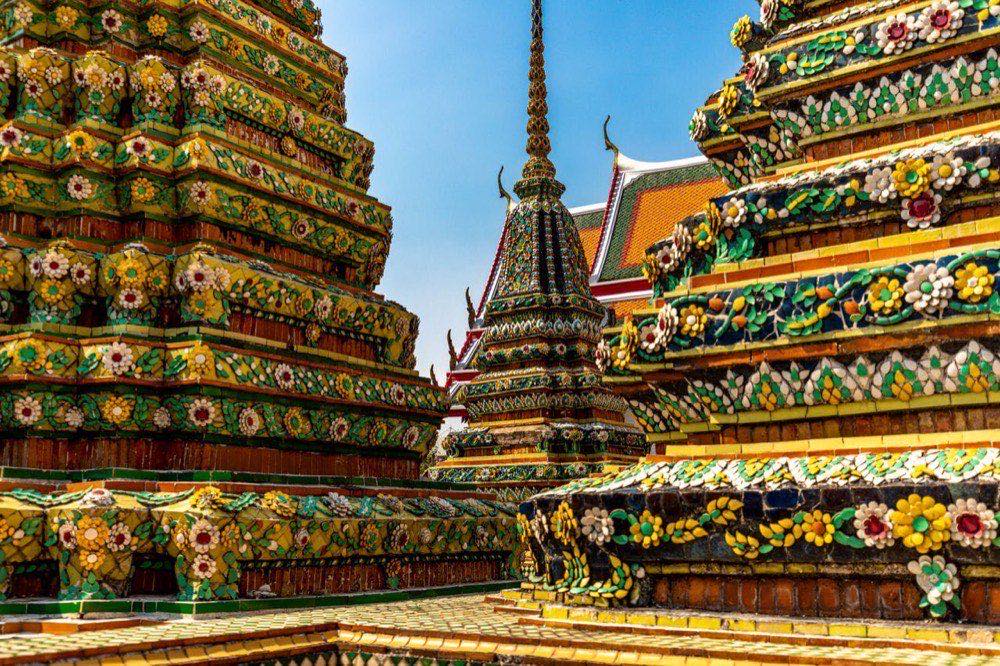 Tiled chedis at Wat Pho, Bangkok.
Thailand is one of Southeast Asia’s most visited countries and English proficiency is concentrated where tourism is densest.
Bangkok - At hotels, restaurants, tour operators, Grab drivers, and BTS/MRT stations, English is functional. On Khao San Road and Sukhumvit, staff often speak it well. At street food stalls in Chinatown (Yaowarat), on the Chao Phraya ferry, and in older residential neighbourhoods, Thai is the default and English may be minimal.
Chiang Mai - In the Old City and Nimman Road, English-speaking staff are common at cafes, guesthouses, and trekking agencies. At the Warorot local market and with songthaew (shared truck taxi) drivers, Thai is needed.
Phuket, Krabi, Koh Samui - Resort staff, dive operators, and ferry ticket sellers typically speak enough English for transactions. Away from the tourist strips, English drops off sharply.
Smaller cities and rural areas - Chiang Rai, Kanchanaburi, Pai, and Isaan provinces have limited English outside guesthouses and popular restaurants. Basic Thai phrases become genuinely useful here rather than optional.
A practical note on menus. Many local restaurants - particularly those serving authentic regional food rather than tourist versions - have menus only in Thai. Pointing at what another diner is eating remains universally understood, but knowing “pet” (spicy), “neua” (meat), “jay” (vegetarian), and “aroi” (delicious) covers most menu conversations you’ll need.
For getting around without language barriers, our getting around Thailand guide covers the specific transport vocabulary for taxis, tuk-tuks, songthaews, and trains in detail. The customs and etiquette guide covers broader cultural norms including temple dress, tipping, and social behaviour alongside the language notes above.
Book Your Trip
- eSIM - Stay connected from landing
- Travel Insurance - Get covered before you go
- Flights - Find the best fares to Thailand
- Tours - Browse Bangkok cultural tours
See also: Basic Thai phrases · Thailand customs and etiquette · Getting around Thailand