Chiang Rai Province Travel Guide: Temples, Hill Tribes
Chiang Rai province: White Temple, Blue Temple, Black House Museum, the Golden Triangle and hill tribe villages across Thailand's far north.
Chiang Rai province sits at the northernmost point of Thailand, where the country narrows to a wedge between Myanmar and Laos. The Mekong River marks the border in the east; the mountains of the Golden Triangle rise in the north. It is a province of striking contrasts — three of Thailand’s most extraordinary contemporary temples draw thousands of visitors to the provincial capital, while the highland areas beyond the city contain hill tribe villages, royal development projects, and some of the country’s most dramatic mountain scenery.
The province is smaller than it feels on a map and rewards a slow approach. The city of Chiang Rai makes a comfortable base. Day trips reach the Golden Triangle, Doi Tung, Mae Salong, and Chiang Khong in under three hours by road.
Key Attractions
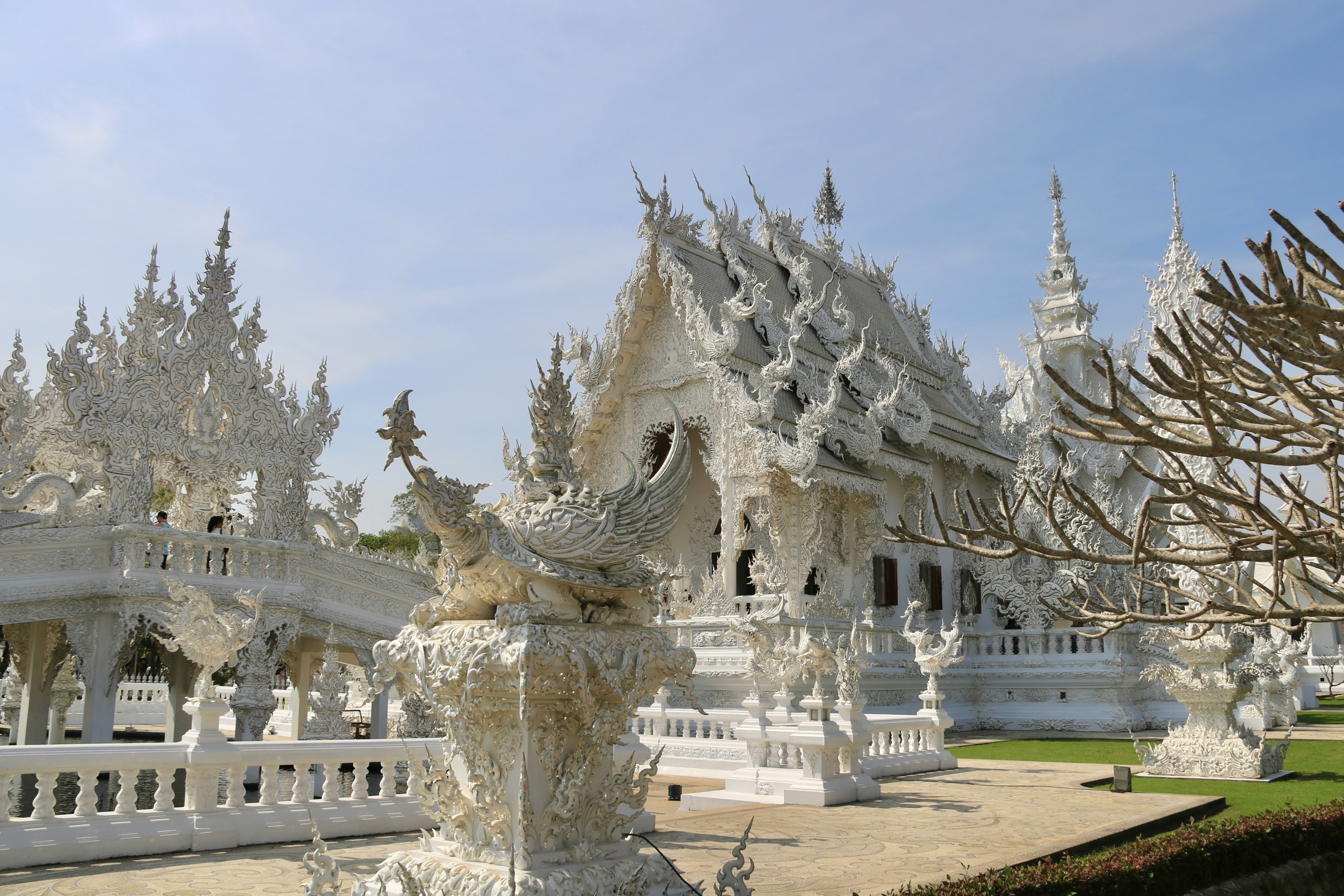
Wat Rong Khun (White Temple)
The most visited site in the province sits approximately 13km south of Chiang Rai city on the main road to Chiang Mai. Wat Rong Khun is a contemporary Buddhist temple created by Thai visual artist Chalermchai Kositpipat, who began construction in 1997 and has stated his intention to continue expanding it throughout his lifetime.
The exterior is built entirely in white plaster embedded with mirror glass fragments that shimmer intensely in sunlight. The approach crosses a bridge over a pool filled with painted hands reaching upward — symbolic of those trapped in the cycle of rebirth. The main building contains murals that incorporate contemporary imagery alongside Buddhist iconography.
Entry: Free for the grounds. The photography permit for the interior ordination hall costs approximately ฿100 as of 2026. Opening hours: Tuesday to Sunday, 8am–6pm. Closed Monday. Arrive before 10am to avoid the coach tour crowds.
Wat Rong Suea Ten (Blue Temple)
Three kilometres from the centre of Chiang Rai city, Wat Rong Suea Ten — commonly called the Blue Temple — offers a quieter alternative to the White Temple while being no less visually striking. The original structure dates to 1522. The current incarnation was designed by artist Phuttha Kabkaew and completed in 2016, with deep blue and gold exterior walls and murals of unusual intensity covering the interior.
The name translates as “Temple of the Dancing Tiger” — a reference to the tigers once said to cross the nearby Kok River at this point.
Entry: Free. Opening hours: Daily 7am–9pm. The evening lighting from around 6pm makes it worth a second visit if you arrive during the day.
Baan Dam (Black House Museum)
At the northern edge of Chiang Rai city, Baan Dam is the life’s work of National Artist Thawan Duchanee — a complex of approximately 40 dark timber structures set across a garden compound. Each building is decorated with animal bones, skins, and horns; dark woodcarvings; and ceramic objects collected over decades. The effect is deliberately unsettling and unlike anything else in Thailand.
Duchanee described the compound as a meditation on death and the darker aspects of human experience. He died in 2014 and is buried on the grounds.
Entry: Approximately ฿80 as of 2026. Opening hours: Daily 9am–5pm. Allow 1–2 hours.
The Golden Triangle
Where the Mekong River meets the Ruak River, the borders of Thailand, Laos, and Myanmar converge at a point known as the Golden Triangle — named for its historical role as the centre of the opium trade. The town of Sop Ruak (approximately 60km north of Chiang Rai city) has a viewpoint over the confluence, an outdoor Buddha image, and two small museums covering the history of the opium trade.
The Hall of Opium at the Golden Triangle Park is the more substantive of the two museums — a serious and well-designed exhibition that traces the history of opium cultivation and international drug policy. Entry: Approximately ฿200 as of 2026. Opening hours: Tuesday to Sunday, 8:30am–4pm.
The viewpoint itself is free. Boat trips across to the Laos side (the town of Ban Huay Xai is visible across the river) run approximately ฿150–400 depending on length. Browse Golden Triangle day tours from Chiang Rai that include Doi Tung and Mae Salong in a single trip.
Doi Tung Royal Villa and Mae Fah Luang Garden
In the mountains approximately 45km northwest of Chiang Rai city, Doi Tung was the mountain estate of the Princess Mother (mother of King Bhumibol Adulyadej). Her development project transformed former opium-growing villages into sustainable agricultural communities, and the area remains a working example of alternative development.
The Royal Villa itself — an alpine-style building designed in 1987 — is open to visitors with guided entry. The Mae Fah Luang Garden below it is an extensive and well-maintained garden with flowering plants from across Asia.
Royal Villa entry: Approximately ฿90 as of 2026. Garden entry: Approximately ฿80 as of 2026. Combined ticket: Approximately ฿150. Opening hours: Daily 7am–5:30pm. The road up from the valley is steep and narrow — songthaews run from the market in Ban Huai Khrai, or hire a private vehicle.
Getting There from Chiang Mai
By bus: Buses from Chiang Mai’s Arcade Bus Terminal run throughout the day, taking approximately 3–4 hours depending on route and stops. Cost approximately ฿150–250. This is the most straightforward option for budget travellers and leaves you at Chiang Rai Bus Terminal 1, from which songthaews and tuk-tuks connect to the city centre.
By car or motorbike: The main route (Route 118 east from Chiang Mai, approximately 170km) takes approximately 3 hours in good traffic. An alternative mountain route via Doi Saket and Wang Kaen is longer but more scenic. Car rentals in Chiang Mai run approximately ฿1,200–2,000/day; motorbike rentals approximately ฿250–400/day.
By air: Chiang Rai International Airport (CEI) receives direct flights from Bangkok (Don Mueang and Suvarnabhumi), taking approximately 1 hour 20 minutes, with fares from approximately ฿700–2,500 one way depending on booking lead time. There are no scheduled direct flights between Chiang Mai and Chiang Rai; the bus or road is the correct connection.
Where to Stay
Budget — Baan Bua Guest House: Well-regarded guesthouse in central Chiang Rai, a 4-minute walk from the Clock Tower and close to the Saturday Night Walking Street. Garden setting, on-site restaurant, air-conditioned rooms. Rates approximately ฿500–900 per night as of 2026. Baan Bua Guest House
Mid-range — The Legend Chiang Rai Boutique River Resort & Spa: Thai Lanna-style villas and studios set along the Mae Kok River approximately 1km from the city centre. An infinity pool overlooks the river, and three restaurants serve a mix of Thai and international food. The Chiang Saen Spa runs a full treatment menu. Rates approximately ฿2,500–5,000 per night as of 2026. The Legend Chiang Rai Boutique River Resort & Spa
Luxury — Anantara Golden Triangle Elephant Camp & Resort: Situated directly at the Golden Triangle confluence with views into Myanmar and Laos across the Mekong, this is one of Thailand’s most dramatically positioned luxury properties. The elephant programme is an ethical sanctuary model; guests can accompany and bathe the resident elephants. Rooms and villas include balconies over the river. Rates approximately ฿12,000–28,000 per night as of 2026. Anantara Golden Triangle Elephant Camp & Resort
Where to Eat
Lung Eed Local Food is a well-known northern Thai restaurant near the night bazaar area — small, busy, no-frills, and recommended by most food-focused visitors to Chiang Rai. The menu covers northern Thai standards: larb, sai ua sausage, nam prik noom with vegetables, and khao soi. Most dishes run approximately ฿60–130.
The Night Bazaar (off Phahonyothin Road, open evenings from around 6pm) has a large food court area where you can eat your way through grilled meats, papaya salad, pad thai, mango sticky rice, and northern dishes at ฿40–80 per portion. This is the most practical dinner option for travellers without strong restaurant preferences.
Cabbages & Condoms (a regional chain associated with the Population and Community Development Association) serves reliable Thai food in an open garden setting approximately 10 minutes from the night bazaar. Prices run approximately ฿150–350 per dish; profits support community health programmes.
Doi Chaang Coffee originated in a village community in Chiang Rai province — the café near the night bazaar sells the full range and offers a good option for breakfast or an afternoon break. Single-origin beans from the hills that surround the city are the speciality.
Best Time to Visit
November to February is the peak season for good reason: daytime temperatures in Chiang Rai city average 26–30°C, nights drop to 14–18°C, and the skies are reliably clear. Mornings in the mountains around Doi Tung and Mae Salong can be cold enough for a jacket in December and January.
March and April bring agricultural burning across northern Thailand. Air quality in Chiang Rai is noticeably affected — AQI readings above 150 are common in March, limiting visibility and making outdoor activity uncomfortable for some visitors. This period also contains Songkran (13–15 April), which is a significant celebration across the province.
May to October is wetter, with afternoon rain most days from June through September. The hills turn green and the Kok River rises; waterfalls run at full volume. Accommodation prices drop by 20–40% compared with peak season, and the city’s temples are significantly less crowded.
Day Trips from Chiang Rai City
Doi Mae Salong: A mountain town approximately 80km northwest of Chiang Rai, settled by Chinese Nationalist Army veterans who retreated into northern Thailand in 1949. The area is planted with oolong tea fields and the town has a distinctly Yunnanese character — Chinese shophouses, tea houses, and a Mandarin-speaking population. The drive up is spectacular; allow 2 hours each way from Chiang Rai.
Chiang Saen and the Golden Triangle: The ancient walled city of Chiang Saen (founded 7th century) sits on the Mekong approximately 60km northeast of Chiang Rai. The ruined chedis and a small museum cover the Lanna-era history of this border town. Sop Ruak (the Golden Triangle viewpoint) is a further 8km north. Both are easily combined into a half-day trip.
Mae Sai: Thailand’s northernmost town sits on the border with Myanmar, approximately 90km north of Chiang Rai. The border market on the Thai side sells goods from Myanmar, Yunnan, and across the region; the crossing to Tachileik is open to most foreign visitors with appropriate documentation. Allow 3 hours round trip from Chiang Rai.
Chiang Khong: On the Mekong approximately 180km southeast of Chiang Rai, this border town is the crossing point for the slow boat to Luang Prabang in Laos. It is worth an overnight stay rather than a rushed day trip if you plan to cross into Laos here.
Related guides: Chiang Rai city hub · White Temple tour guide · Where to stay in Chiang Rai · Northern Thailand region guide
Book an experience
Top experiences in Chiang Rai Province Travel Guide: Temples, Hill Tribes
Find the best tours and activities across Chiang Rai Province Travel Guide: Temples, Hill Tribes, with instant confirmation and free cancellation on most bookings.