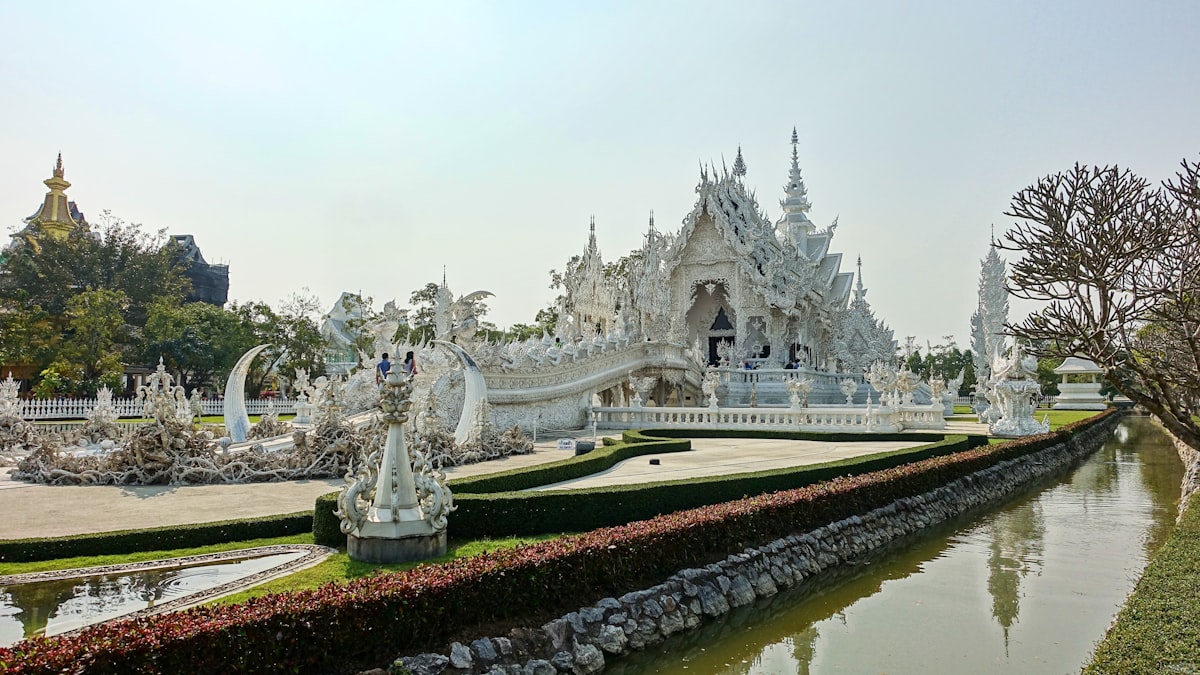
Chiang Rai is a different proposition from Chiang Mai - slower, smaller, and free of the tourist-party infrastructure that fills the bigger city’s old town. The city itself is compact and easy to navigate, and the surrounding province holds some of Thailand’s most interesting day-trip territory: the White Temple, the Blue Temple, the Black House Museum, and the Golden Triangle up on the Myanmar and Laos borders. Where you stay shapes how that day-trip circuit works. Here is how the main areas compare.
City Centre: walking distance to everything
The grid around the Night Bazaar, Jetyod Road, and the old clock tower is where most accommodation sits, and for good reason - it puts the market, the best restaurants, the bus and songthaew stops, and the walking streets all within 10 minutes on foot. It is not a large city, so “city centre” covers most of the main sights.
Where to stay in the city centre:
- Budget: Bar-B Guest House on Itsaraphap Road has clean private rooms from approximately ฿350–500 per night as of 2026 - basic but run by people who know the area well. Baan Bua Guest House runs approximately ฿450–700 for a private double with fan or air conditioning.
- Mid-range: Le Méridien Chiang Rai Resort sits just off the main road near the Night Bazaar with a riverside pool - doubles typically run approximately ฿3,500–5,500, and it is one of the best-located mid-to-upper choices in the city. Wiang Inn Hotel, centrally placed and recently renovated, runs approximately ฿1,800–2,800.
- Upper: The Chiang Rai Boutique Hotel on Pemavibhata Road offers contemporary northern-Thai design rooms from approximately ฿3,200–4,800. For the top end, the Anantara Golden Triangle Elephant Camp & Resort is 50 km from the city near Chiang Saen - more on that below.
The Riverside: quieter, greener, short tuk-tuk ride
A cluster of boutique guesthouses and resorts sit along the Kok River, roughly 2–4 km north of the clock tower. The atmosphere is noticeably calmer - garden grounds, river views, cooler mornings - and most places run free or cheap shuttles into town in the evenings.
- Budget/mid: Baan Waroros has wooden bungalows from approximately ฿900–1,400 on a quiet soi near the river, with a good breakfast included at the upper end of the rate range.
- Mid-range: The Laluna Hotel, on the Kok River’s south bank, has a pool and spacious grounds - rooms approximately ฿2,200–3,500. Rimkok Resort, directly on the river with views of the hills, runs approximately ฿2,500–4,000 and has a small spa.
- Luxury: Le Méridien also has a riverside section; its pool overlooks the Kok and the surrounding forested hills, and this is arguably the best pool setting in the city at the ฿4,000–7,000 range as of 2026.
Near the White Temple: a quieter base for day-trippers
If your main reason to visit is the White Temple (Wat Rong Khun) and you want to beat the day-tripper crowds from Chiang Mai, staying in or near Ban Pa O - the village cluster south of the city, about 10 km from Wat Rong Khun - puts you 15 minutes from the temple on roads that are clear by 8 am.
- Mid-range: Baan Tharn Namchai Resort, 8 km south of the city, has garden villas from approximately ฿2,000–3,200. Facilities are limited - this is a quiet rural retreat, not a full-service hotel.
- Alternative: Most visitors are better off staying in the city and doing an early start. The temples open from approximately 6:30 am (check current times before visiting), so a 7 am departure from the city centre still beats the tour-bus rush.
The Golden Triangle: for a full border-area immersion
If the Mekong, Myanmar, and Laos borders are your main draw rather than the city itself, the Anantara Golden Triangle Elephant Camp & Resort near Chiang Saen (50 km north) is one of Thailand’s most distinctive luxury stays - private-pool villas with three-country views from approximately ฿15,000–28,000 per night as of 2026. It is expensive, but there is genuinely nothing like waking up at the confluence of the Mekong and Ruak rivers with Myanmar visible across the water. Transfers from Chiang Rai city take about an hour by arranged car.
Getting to Chiang Rai
Chiang Rai International Airport (CEI) sits 8 km north of the city centre. Taxis and ride-apps run approximately ฿150–250 to the centre. By bus from Chiang Mai, the journey is 3–4 hours depending on the route (Greenbus departs from Chiang Mai Arcade Terminal) - approximately ฿130–200 one way as of 2026. Private transfers take about 3 hours by road.
Seasonal pricing and timing
High season runs November to February, when room rates can be 30–50% above the low-season baseline. The Chiang Rai Flower Festival (usually first week of February) fills the city - book 4–6 weeks ahead for those dates. The wet season (June–October) brings the lowest prices and emptiest roads, but smoke haze from burning (worst March–April) can be a concern in spring; this actually makes November–February the best combination of clear skies and cool temperatures. For things to do while you’re based here, see our Chiang Rai city guide and the White Temple guide. To book day trips to the Golden Triangle, hill-tribe villages, or cooking classes, browse Chiang Rai tours before you arrive.