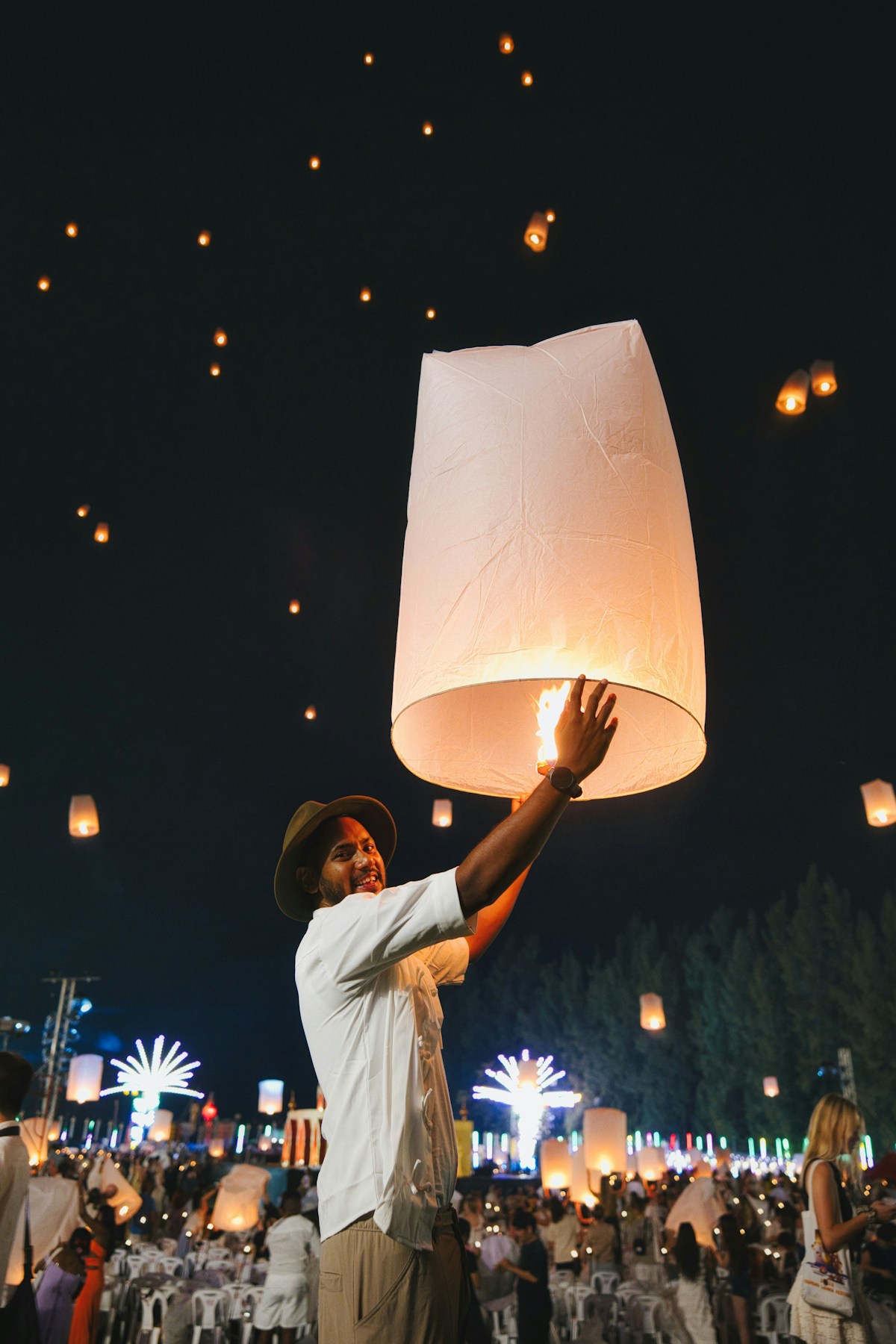
November in Chiang Mai is when northern Thailand’s most iconic festival turns the sky into a river of light. Thousands of paper lanterns drift upward simultaneously, catching warm air currents and rising silently until they become indistinguishable from stars. If you’re planning to be here for Yi Peng - or trying to understand how it relates to Loy Krathong - this guide covers everything you need to know.
Yi Peng vs Loy Krathong: Two Different Festivals
These two festivals share the same full-moon night but come from different traditions.
Loy Krathong is a nationwide Thai festival. On the evening of the full moon of the twelfth lunar month (November), people throughout the country float elaborately decorated krathong - small baskets made from banana trunk sections, flowers, incense, and candles - on rivers, canals, and ponds. The act honours Mae Khongkha, the goddess of water, and is thought to wash away bad luck and express gratitude. Bangkok’s Chao Phraya riverbanks fill with thousands of these floating lights. Chiang Mai’s Ping River does too.
Yi Peng (also written “Yee Peng”) is a northern Thai festival rooted in Lanna culture, the ancient kingdom centred on Chiang Mai. Its defining tradition is the release of khom loi - large cylindrical sky lanterns made from thin rice paper stretched over a bamboo frame, lit by a burning wick beneath. As the air inside heats up, the lantern rises and drifts skyward. Yi Peng overlaps with Loy Krathong night, but the city celebrates for several days around it: temples hold candlelit processions, the old city decorates its moat with lanterns, and markets run longer hours.
The combined effect, particularly on the main release night, is extraordinary: the sky fills with lanterns while the river fills with floating krathong, and fireworks punctuate both.
When Does Yi Peng 2026 Take Place?
Both festivals fall on the full moon of the twelfth lunar month - typically in November. For 2026, the full moon falls on 24 November, with the Tourism Authority of Thailand running official events from 24–26 November. Most visitors target a window of four to five days around the full moon to catch processions, market activity, and the main lantern release.
Check the Thailand in November guide for the full calendar of what’s happening across the country during this month, and our best time to visit guide for seasonal context on weather and crowds.
The Main Events in Chiang Mai
Mae Jo Mass Lantern Release (Ticketed)
The event that fills Instagram feeds is the organized mass release at Mae Jo University, about 12 km north of Chiang Mai city centre. Thousands of attendees in white clothing sit in a large open field, each holding a paper lantern. After a countdown, everyone releases simultaneously - a wall of light rises into the sky.
This event is run by private event companies (not the university) and is entirely ticketed. Standard tickets cost approximately 3,000–3,500 THB (around USD 85–100) as of 2026 and include one sky lantern. Premium packages - with better field positioning, dinner, and additional lanterns - range from 5,000 to 9,000 THB. Book as early as possible: tickets go on sale in July or August and are typically sold out by September.
Tour operators on GetYourGuide list Mae Jo packages with transport from Chiang Mai hotels, a white outfit, lantern, and dinner for approximately USD 90–120 per person. Search “yi peng lantern festival chiang mai” on GYG to compare current packages - operators include Chiang Mai Midnight Flower, Amazing Chiang Mai Tours, and several other local specialists.
Riverside Krathong Floating
Along the Ping River - particularly the stretch near Nawarat Bridge, Tha Phae Gate, and the Night Bazaar - the krathong floating runs throughout the main evening. You can buy pre-made krathong at riverside stalls for approximately 50–150 THB depending on size and decoration. Handmade banana-trunk versions are more environmentally friendly than styrofoam alternatives; ask vendors specifically for natural materials. This is free to participate in and one of the most atmospheric ways to spend the evening.
Temple Processions and Old City Events
Wat Phra Singh, Wat Chedi Luang, and Wat Suan Dok all hold candlelit processions and merit-making events in the evenings leading up to and including the main night. These are free to observe and give a quieter, more local experience than the stadium-style Mae Jo event.
How to Get Tickets
- Official event companies: Search for Mae Jo Yi Peng packages on GetYourGuide or directly through operators like Amazing Chiang Mai Tours and Chiang Mai Midnight Flower. Prices are similar across operators; the differences are in transport pickup, meal quality, and field positioning.
- Book in August at the latest: By October, legitimate tickets at face value are extremely scarce. Third-party resellers appear at inflated prices - expect to pay 30–50% more if you wait.
- Budget alternative: Skip Mae Jo entirely. The free release from Nawarat Bridge or the moat corners sees thousands of lanterns in the sky simultaneously - you get the visual without the ticket cost.
Best Viewing Spots (Free)
- Nawarat Bridge - broad open view over the Ping River, lanterns rise from both banks, best vantage for combined sky and water display
- Tha Phae Gate moat corner - central, atmospheric, surrounded by the old city walls lit up
- Three Kings Monument plaza - open square in the old city, clear sky views, locals gather here
- Nimmanhaemin Road rooftops - several rooftop bars raise prices but offer elevated views; book ahead
Where to Stay During Yi Peng
Hotels in Chiang Mai, especially near the old city and Nimman district, book out months ahead for Yi Peng weekend. Expect rates to be 40–80% higher than the standard November rate.
- Dhara Dhevi Chiang Mai (deluxe resort, ~12 km from city centre) - Lanna-style architecture, extensive gardens; rates from approximately USD 400/night during the festival
- 137 Pillars House (boutique heritage hotel, Nimmanhaemin area) - colonial property with pool, good restaurant; from approximately USD 200–280/night
- Akyra Manor Chiang Mai (design hotel, Nimman) - smaller boutique option in the heart of the café district; from approximately USD 120–160/night
- Tamarind Village (old city, close to Tha Phae Gate) - traditional Lanna setting inside the moat; from approximately USD 130–200/night
- Baan Thai 1912 (old city) - restored teak house, intimate and character-rich; from approximately USD 90–130/night
Book directly or via Hotels.com/Booking.com by August for November travel. All prices are approximate and vary by year.
Where to Eat Near Festival Venues
Near the old city and Nawarat Bridge:
- Huen Phen (Ratchamankha Rd, inside the old city) - classic northern Thai specialities: khao soi, nam prik noom, laab meuang. Mains approximately 80–200 THB. Arrive early; queues form by 7 pm on festival nights.
- The Riverside Bar & Restaurant (Charoenrat Rd, Ping River) - riverside terrace with full Thai and international menu; good position for post-krathong dinner. Mains 200–450 THB.
- Khao Soi Khun Yai (Charoen Prathet Rd) - low-key spot for the city’s best khao soi, 60–80 THB a bowl, usually open until late.
Near Nimman district (for 137 Pillars and Akyra guests):
- Blackitch Artisan Kitchen (Nimman Soi 7) - creative Thai tasting menus, approximately 1,500–2,500 THB per person with wine. Book well ahead.
- Pun Pun Organic Vegetarian (Suthep Rd, near Chiang Mai University) - Northern Thai, entirely organic, relaxed atmosphere; 80–180 THB.
Visiting Chiang Mai During Yi Peng
Read our full Chiang Mai guide for temple itineraries, day-trip options, and neighbourhood breakdowns. The festival is November-specific, but the city’s Lanna heritage, cooking schools, and Sunday Walking Street make it worth visiting year-round.
What to Wear and Photography Tips
- White clothing is customary at Mae Jo and appreciated at temple events as a mark of respect. Many hotels and markets sell plain white shirts during the festival period; expect to pay 150–300 THB.
- Photography: Wide-angle or standard lens works best for the mass release - individual lanterns are unpredictable subjects; the spectacle is the collective. A tripod and a 2–4 second exposure captures the trails. During casual releases around the city, a wide f/2.8 or brighter lens handles the low light well.
- Phone cameras: Festival conditions (smoke, moving lanterns, crowds) challenge phone auto-focus. Enable night mode and stabilise your phone against a railing or bag.
Environmental Concerns
Sky lanterns are beautiful but have real downsides: wire frames cause agricultural damage and can harm livestock when they land, and the risk of fire is non-trivial in dry northern Thailand (Yi Peng is late in the dry-wet transition). Mae Jo’s event has protocols and a cleared landing zone. Outside organized events, some visitors choose to participate in krathong floating instead - the environmental impact of natural banana-trunk krathong is considerably lower than sky lanterns. If you do release lanterns, use wire-free bamboo versions (widely available) and avoid releasing near temples with thatched roofs or open farmland.
Plan Your Trip
Yi Peng is best experienced as part of a broader northern Thailand stay — our Chiang Mai city guide covers accommodation areas to prioritise for festival access, particularly the Nimmanhaemin and Old City zones. The one week in northern Thailand itinerary shows how to combine the festival with Chiang Rai and Pai in a single trip. Book accommodation 3-4 months ahead for festival dates; our budget guide to Thailand notes that Chiang Mai hotel prices roughly double during Yi Peng week.
Book Your Trip
- Flights - Find the best fares to Thailand
- Travel Insurance - Get covered before you go
- eSIM - Stay connected from landing
- Car Rental - Compare prices across providers
See also: Chiang Mai city guide · Best time to visit Thailand · One week North Thailand itinerary