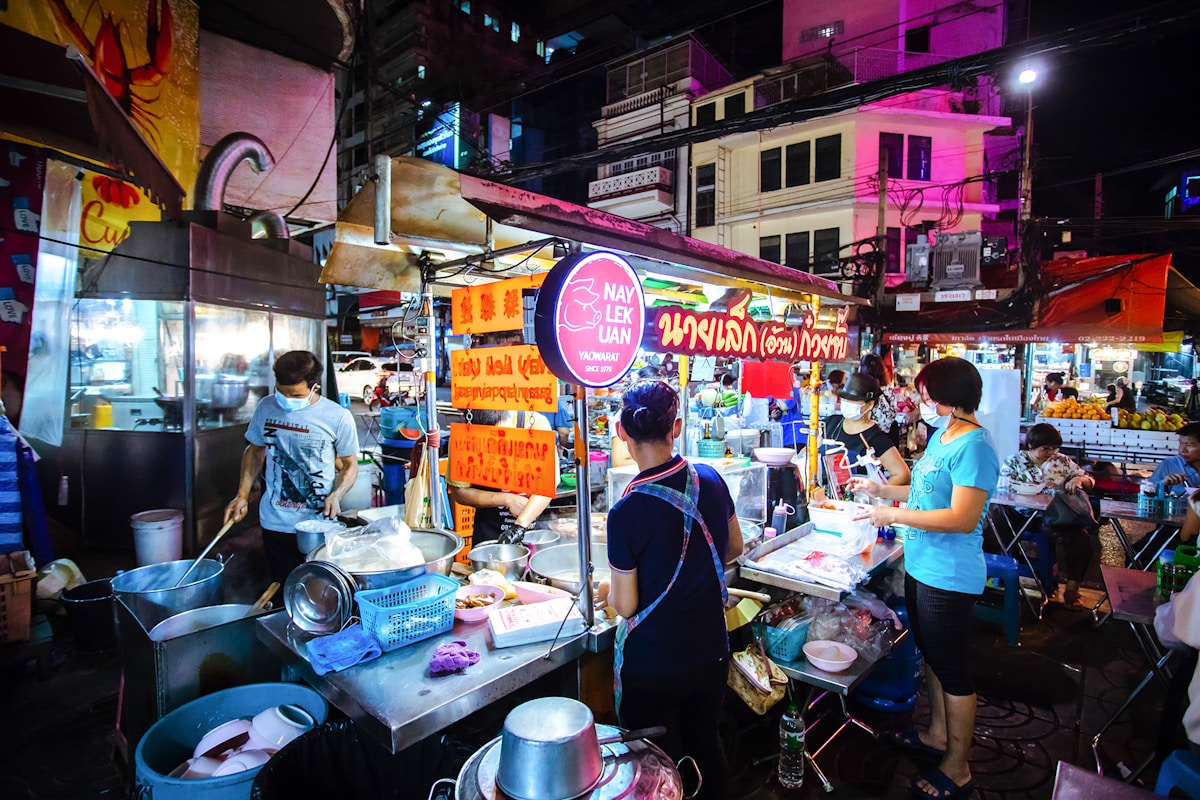
Why Thai street food is worth your full attention
Street food is not a secondary option in Thailand - it is the primary food culture. Most Thai people eat at least one meal per day from a street stall, market canteen, or roving cart. The dishes served at the best pavement stalls have been refined over decades, often generations, of a family cooking one or two things to a precise standard. A bowl of boat noodles from a specialist vendor at a Bangkok market will outperform the same dish at most sit-down restaurants.
Understanding a few principles about how Thai street food works - what to order, where to find it, what it should cost - makes the difference between eating well on a budget and settling for tourist-facing imitations.
The essential dishes
Pad Thai (ผัดไทย) - Rice noodles stir-fried with egg, tofu or shrimp, bean sprouts, and spring onions over charcoal or high gas heat, finished with crushed peanuts, dried chilli flakes, and a wedge of lime. Street versions from a dedicated pad thai cart with a smoking wok cost approximately THB 50–80 as of 2026. The quality indicator is the wok heat - a proper pad thai has caramelised edges and distinct noodle strands, not a soggy clump.
Khao Man Gai (ข้าวมันไก่) - Poached or steamed chicken served over rice cooked in chicken stock, with a side of fermented soybean and ginger dipping sauce and a light chicken broth soup. This is the dish Bangkok eats for breakfast. Dedicated khao man gai shops open as early as 5am and close when they sell out, often by mid-morning. A plate costs approximately THB 50–70. The quality of the dipping sauce is the point of difference between vendors.
Pad Kra Pao (ผัดกะเพรา) - Minced pork or chicken stir-fried with Thai holy basil, garlic, fresh chilli, and a small amount of oyster sauce and fish sauce, served over jasmine rice with a fried egg (kai dao) on top. This is the most commonly eaten everyday dish in Thailand. Approximately THB 50–70 with egg at any market canteen or street cart. Ask for “pet mak” (very spicy) to get the authentic version - most stalls default to mild for obvious reasons.
Boat Noodles (ก๋วยเตี๋ยวเรือ) - Small, intensely flavoured bowls of rice or egg noodles in a rich broth made with blood, pork, and spices. Originally sold from canal boats, now found at dedicated market stalls throughout Bangkok and central Thailand. Bowl size is small by design - the tradition is to order four or five in a row. Approximately THB 35–50 per bowl as of 2026. Victory Monument area in Bangkok has a concentration of boat noodle vendors.
Som Tam (ส้มตำ) - Green papaya salad pounded to order in a clay mortar: shredded unripe papaya, lime juice, fish sauce, palm sugar, dried shrimp, tomatoes, and bird’s eye chilli. A defining dish of Isan (northeastern Thai) cuisine. Spice level is customisable - indicate your tolerance to the vendor. Eaten with sticky rice and grilled chicken (gai yang). Cost approximately THB 40–60 as of 2026.
Tom Yum Goong (ต้มยำกุ้ง) - Hot and sour prawn soup with lemongrass, galangal, kaffir lime leaves, and bird’s eye chilli. The correct version is intensely aromatic and sour, nothing like the diluted versions served at tourist restaurants. Found at market canteens and proper Thai restaurants. Approximately THB 100–180 for a bowl or shared pot.
Mango Sticky Rice (ข้าวเหนียวมะม่วง) - Glutinous rice soaked in sweetened coconut cream, served with sliced ripe mango (Nam Dok Mai variety) and a drizzle of salted coconut cream. The definitive Thai dessert. Best from March to May when the best mangoes are in season, but available year-round. Street stalls and market dessert vendors: approximately THB 60–100 as of 2026.
Khao Soi (ข้าวซอย) - This is a northern Thai dish - egg noodles in a coconut curry broth, topped with crispy fried noodles and served with pickled mustard greens, shallots, and lime. Found authentically only in Chiang Mai, Chiang Rai, and parts of northern Thailand. Do not order it in Bangkok and expect the real thing.
Satay (สะเต๊ะ) - Marinated meat (pork or chicken) on bamboo skewers, grilled over charcoal and served with peanut sauce and pickled cucumber relish. Common at markets throughout the country. Approximately THB 15–25 per skewer as of 2026.
Where to find street food by city
Bangkok
Bangkok’s street food is the most diverse in the country - not because it has a distinct regional cuisine (central Thai food is the baseline), but because Bangkok draws vendors from every province.
Yaowarat Road (Chinatown) - The single most concentrated street food street in Bangkok. Best after 7pm when the charcoal smoke from dozens of grills fills the air. Roast duck over rice from T&K Seafood (known for its grilled prawns) and other long-standing stalls. Chinese-Thai hybrid dishes - steamed dim sum, roast pork (moo daeng), and goose soup. Accessible via MRT Hua Lamphong, 10-minute walk.
Or Tor Kor Market (อตก.) - Directly beside Chatuchak Weekend Market (BTS Mo Chit). A covered market with the highest-quality prepared food in the city - durian vendors, specialty fruit, fresh papaya salad made with live crab, khao man gai from dedicated stalls. Not cheap by street food standards but genuinely excellent.
Victory Monument area - A ring of covered market stalls and street vendors around the BTS Victory Monument station. Boat noodles are the speciality here. Also strong for Isan food (som tam, larb, sticky rice).
Chatuchak Weekend Market - Section 26 and the food court near the outer ring. Pad thai, grilled meats, coconut ice cream, and Thai desserts in a market setting. Saturday and Sunday only.
Chiang Mai
Chiang Mai’s street food scene centres on the walking streets and market areas, with distinct northern Thai dishes that cannot be found authentically in Bangkok.
Sunday Walking Street (Thanon Wualai Saturday / Tha Phae Road Sunday) - The Sunday Walking Street on Tha Phae Road is the largest. Northern food specialities: sai oua (herbed pork sausage), nam prik noom (roasted green chilli dip served with sticky rice), khao soi, and miang kham (betel leaf wraps). Best 5–10pm.
Muang Mai Market (ตลาดเมืองใหม่) - The main wholesale produce market northeast of the old city. One of the best morning markets in northern Thailand for cheap local food - northern curries, kaeng hang le (Burmese-influenced pork belly curry), and Thai breakfast staples.
Nimmanhaemin (Nimman) area - Higher-end cafes and food stalls. Better for coffee and contemporary Thai food than traditional street food - but the street food that does exist here is made for a local rather than tourist audience.
Phuket
Phuket’s street food bears the strong imprint of its Hokkien Chinese heritage - different from the central Thai street food canon.
Phuket Old Town (Thalang Road / Dibuk Road) - The most atmospheric area for food in Phuket. Look for Oh tao (oyster cake - a crispy fried oyster pancake), mee hokkien (Hokkien-style noodles with pork and seafood), and kanom jeen with curry sauces. Morning hours are best. Weekend walking street (Lard Yai) on Sunday evenings.
Patong Road markets - More tourist-facing but convenient if you’re staying on the beach. Pad thai, satay, fresh seafood grilled to order. Prices are higher than the old town.
Dietary considerations
Vegetarian/Vegan - Look for yellow-flagged “jay” (เจ) stalls. Jay food is strictly vegan (no animal products, no garlic or onion in some versions) and is common during Buddhist observance periods. Outside jay stalls, true vegetarian Thai food is difficult - fish sauce and shrimp paste are foundational ingredients.
Halal - Southern Thailand (Hat Yai, Pattani, Narathiwat) has the strongest halal street food scene. In Bangkok, the Pratunam and Sukhumvit areas have halal-certified stalls. Look for green “halal” certification signs in Thai and Arabic script.
Gluten - Rice and rice noodles are naturally gluten-free. Wheat noodles (ba mee) and Chinese-influenced dishes may contain wheat. Soy sauce often contains wheat. If severe allergy, confirming with vendors is essential.
Nut allergies - Peanuts appear in pad thai, satay sauce, some curries, and many desserts. Alert staff clearly, as cross-contamination from shared woks is common.
Safety and practical tips
Busy stalls with high turnover are safer than quiet ones. Food that has been sitting in the heat for more than a couple of hours is a risk - prioritise freshly cooked dishes. Freshly grilled meats (satay, gai yang), stir-fried dishes, and noodle soups are generally the safest choices because they are cooked to order at high heat.
Ice is safe at the vast majority of Thai street food stalls - commercial ice made from purified water is the standard, identifiable by its tubular shape. Crushed ice, which may be made from tap water, carries more risk.
Tap water is not potable in Thailand. Use bottled water (approximately THB 10–15 for 1.5L) or the filtered water dispensers found in many markets.
Bring small bills - THB 20, 50, and 100 notes. Most street vendors do not accept cards.
Price guide (as of 2026)
| Dish | Typical Street Price |
|---|---|
| Pad thai | THB 50–80 |
| Pad kra pao with rice + egg | THB 50–70 |
| Khao man gai | THB 50–70 |
| Boat noodles (per bowl) | THB 35–50 |
| Som tam | THB 40–60 |
| Satay (per skewer) | THB 15–25 |
| Mango sticky rice | THB 60–100 |
| Fresh coconut | THB 30–50 |
| Tom yum (bowl/pot) | THB 100–180 |
Prices in tourist areas (Khao San Road, Patong Beach) run approximately 2–3x higher. If you’d rather eat with a guide who knows which stalls are worth the queue, browse street food tours across Thailand - Bangkok, Chiang Mai, and Phuket all have well-run evening options.
See also: Bangkok travel guide · Chiang Mai travel guide · Phuket island guide