
Chiang Mai eats differently from the rest of Thailand. This was the capital of the Lanna kingdom, and its food looks towards Myanmar and Yunnan - coconut-poor, herb-heavy, built around sticky rice, pork, and fermented things. It is also absurdly cheap: the best meals in this guide cost under ฿100. Here is what to eat and exactly where to eat it.
Khao soi: the main event
Egg noodles in a turmeric-tinged coconut curry broth, topped with a nest of crispy fried noodles, with pickled mustard greens, raw shallots, and lime on the side. Chicken (khao soi gai) is the classic; beef is the upgrade.
- Khao Soi Khun Yai - the garden shack near Wat Kuan Kama, north of the moat, that most locals name first. Approximately ฿50–60 a bowl as of 2026. Open roughly 10am–2pm, closed Sundays - it sells out, go early.
- Khao Soi Mae Sai (Ratchaphuek Road, Santitham) - the other perennial “best in town” claimant, similar prices, slightly bigger menu.
- Khao Soi Lam Duan Fah Ham - on the khao soi strip along Charoenrat Road east of the river, serving since the 1940s; approximately ฿60–80.
- Khao Soi Nimman - the comfortable sit-down version in Nimman with air-con and a long menu, approximately ฿90–150. Not the purist’s pick, but a good first bowl.
The northern repertoire
Find these at markets and curry shops rather than tourist restaurants:
- Sai ua - coarse pork sausage packed with lemongrass, kaffir lime, and chilli. The benchmark is Sai Ua Praya at Mueang Mai market, or any grill stall at Ton Phayom market; approximately ฿100–150 per 100g.
- Nam prik nuum + kap moo - roasted green-chilli relish with pork crackling and steamed vegetables. Sold in every market; a set costs approximately ฿50–80.
- Gaeng hang lay - Burmese-influenced pork belly curry, sweet-sour with ginger and tamarind, no coconut. Huen Phen in the Old City does the definitive restaurant version (approximately ฿120) - go for lunch at the cheap front canteen or dinner in the antique-filled back room (฿200–350 per person). Reservation recommended for dinner.
- Khao kha moo - braised pork leg on rice. The famous vendor is the Cowboy Hat Lady (Khao Kha Moo Chang Phueak) at Chang Phueak Gate’s night market, approximately ฿50 a plate with a boiled egg. Evenings only.
- Larb kua - northern larb, fried with a dark dried-spice mix. Try it at Larb Ton Koen or any larb shop in Santitham.
- Kanom jeen nam ngiao - fresh rice noodles in a tomato-based broth with pork ribs, dried dok ngiao flowers, bean sprouts, banana flowers, and pork crackling. A distinctly northern dish rarely found in Bangkok; available at morning markets and a handful of dedicated northern Thai restaurants.
Night markets and where locals actually graze
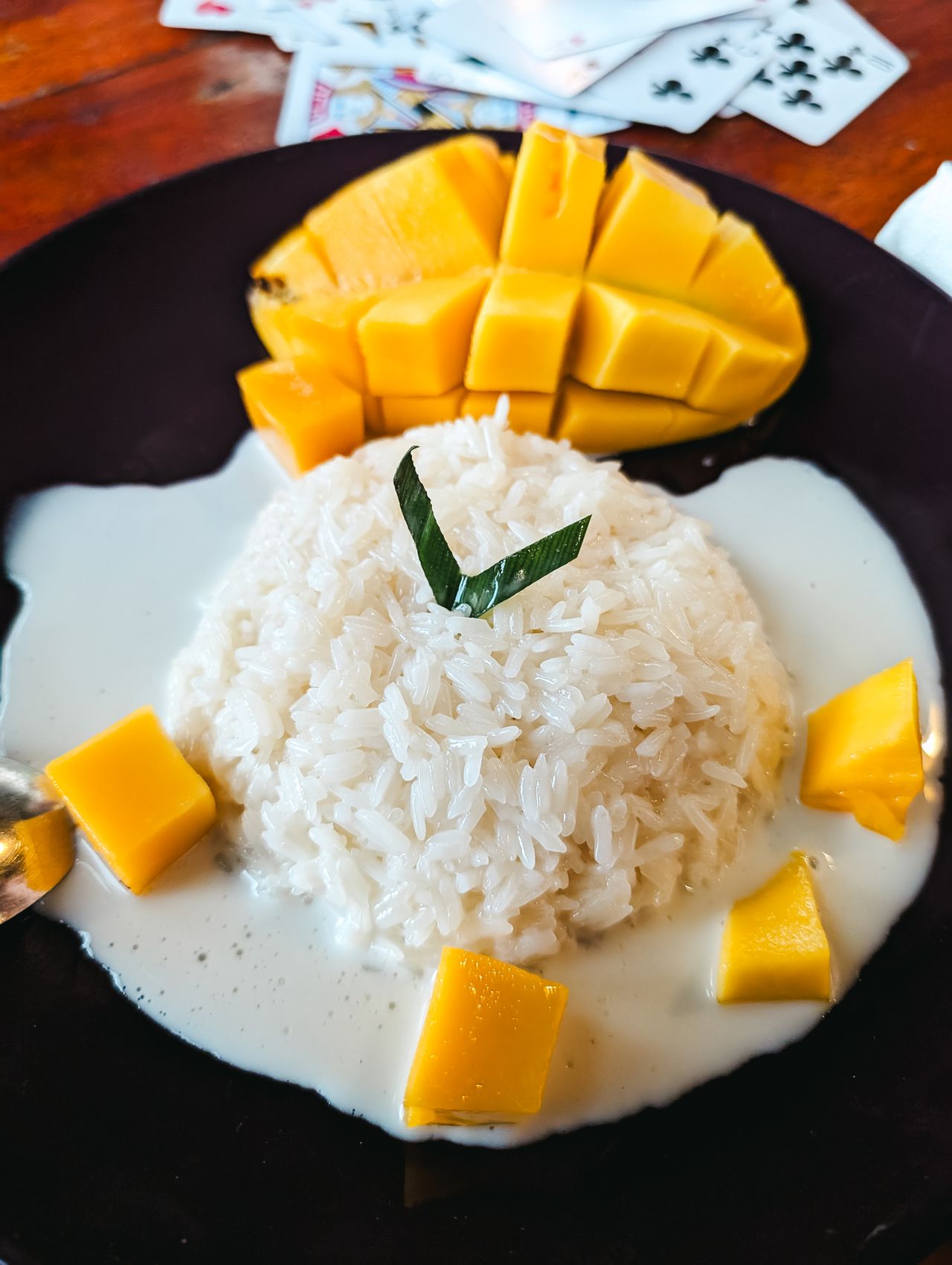 Mango sticky rice with coconut cream.
- Chang Phueak Gate night market - the best pure food market in the Old City orbit, evenings from about 5pm: khao kha moo, grilled chicken, pad thai stalls, most dishes ฿40–80.
- The Sunday Walking Street (Ratchadamnoen Road) - touristy but genuinely good grazing; the food courtyards inside Wat Phan On and Wat Sum Pow are the smart stops. Skewers and noodles ฿20–60.
- Ton Phayom Market (near the university) - the locals’ daytime market for sai ua, fried chicken, and northern sweets to take away.
- Warorot Market (Kad Luang) - the city’s old central market near the river, best in the morning: khao soi and noodle shops tucked among fabric stalls, plus sai ua and kap moo to carry home.
Nimman and independent restaurants
Nimman Road (accessible via the 700 Year Stadium songthaew route) is Chiang Mai’s university-adjacent dining neighbourhood - independent cafes, Japanese-influenced menus, and creative Thai restaurants at ฿150–350 per dish. More comfortable than market eating but less local. Useful for a mid-afternoon meal or a dinner that isn’t queuing at a market stall.
Take a Guided Food Tour of Chiang Mai
 Two elephants in a sanctuary below limestone peaks.
Chiang Mai’s northern Thai food culture is genuinely distinct - the dishes, the ingredients, and the markets where they appear are rooted in Lanna history and Burmese influence that takes some decoding. A guided food tour covers khao soi at the right vendor, sai ua from the right butcher at Warorot, and nam prik nuum with the pork crackling stall that has been there for 30 years - context a solo eat-around rarely delivers. The best tours also run in the morning, which is when the city’s food scene is most alive and most local.
Browse Chiang Mai food tours and cooking experiences to compare operators - evening and morning options both exist, and most sell out in high season.
Coffee
Chiang Mai’s café scene is the best in the country, fed by highland farms in Doi Chang and Doi Inthanon. Roasters worth visiting: Akha Ama Coffee (La Fattoria branch near Wat Phra Singh, beans from the Akha community in Mae Chan), Ristr8to (Nimman, the city’s longest-running specialty bar), Graph Café (moat area, excellent pour-overs), and Baristro (near the moat, reliable espresso). Flat whites and pour-overs approximately ฿70–100 as of 2026. Vegetarians do unusually well in Chiang Mai too; see our vegetarian and vegan Thailand guide for the city’s meat-free khao soi options.
Make a class out of it
The dishes above are exactly what the city’s farm cooking schools teach - pounding your own curry paste once changes how you taste everything afterwards. We compare the schools and prices in our Chiang Mai cooking classes guide. You can also browse Chiang Mai food tours and cooking experiences to compare operators and book ahead - most sell out in high season. And if you are heading south afterwards, recalibrate with our Thai street food guide - the food changes more than the temperature.
Plan Your Trip
Two basics worth sorting before you arrive: travel insurance for Thailand covers medical bills and trip disruptions, and a Thailand eSIM means you have maps and a translation app ready the moment you land in Chiang Mai - helpful when navigating morning markets where vendors speak Lanna dialect and no English. For accommodation, search hotels in Chiang Mai on Booking.com - guesthouses inside or just outside the Old City moat are the most practical base for the morning markets and street food corridors.
See also: Chiang Mai travel guide · Things to do in Chiang Mai · Cooking classes in Chiang Mai · Vegetarian and vegan Thailand · Best Thai dishes