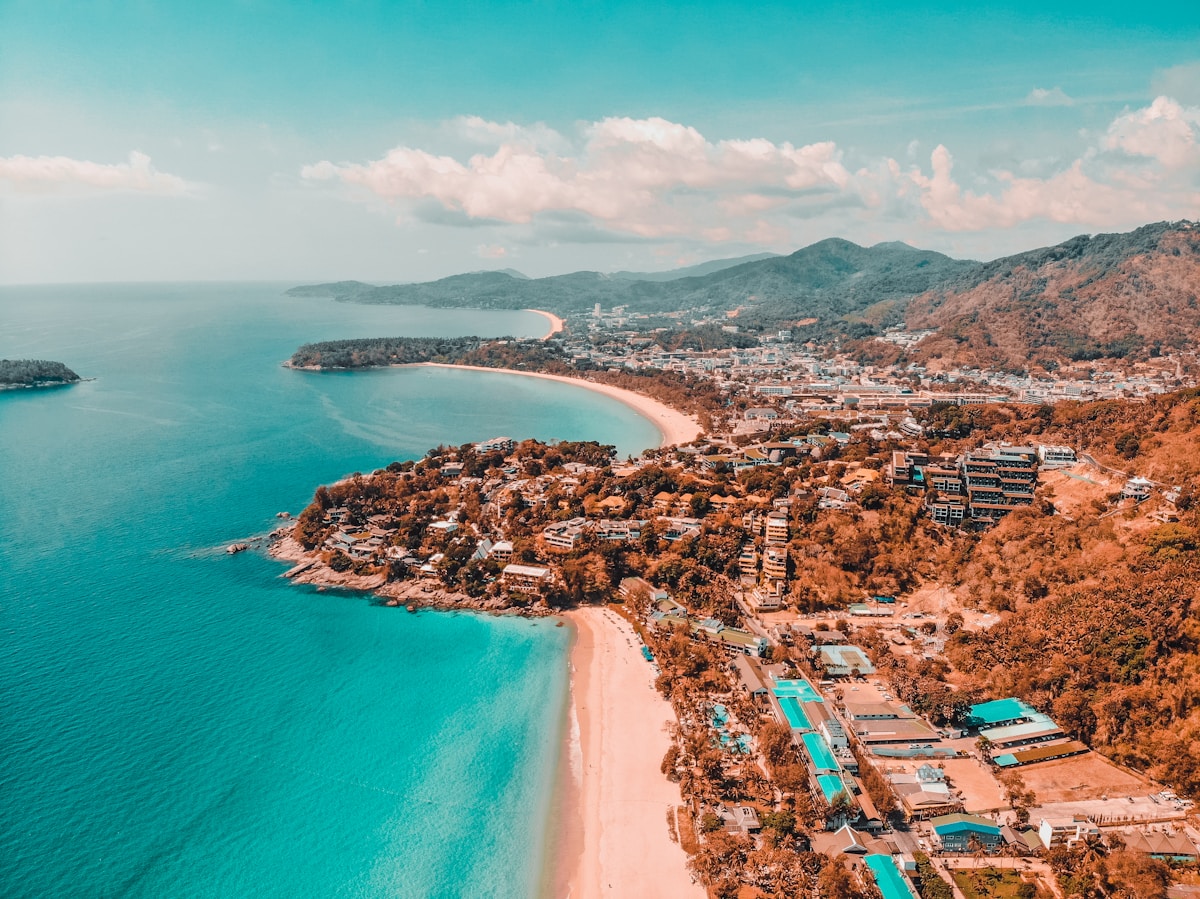
Phuket’s west coast stretches 40km from Rawai in the south to Mai Khao in the north. The beach you choose shapes the entire stay — the zones are genuinely different in character and cost. Here is the honest breakdown.
Kata and Karon: the best-all-round base
Kata is the recommendation for most first-time visitors. The beach is a well-shaped bay with good swimming in the northern section and surfable waves during the low season. Kata Noi (the small cove immediately south) is one of the island’s prettiest beaches. The town behind Kata has a full range of restaurants, cafes, tour operators, and shops within easy walking distance — enough for convenience, not so much that it feels like a resort strip.
Karon, the next bay north, is longer and flatter. It has a slightly older demographic and a stronger Scandinavian package-tour presence. The main advantage over Kata is price — comparable hotels typically cost 10–20% less.
Getting around from here — Kata and Karon are 35–45 minutes from the airport by taxi (approximately ฿600–700). Phuket Town is 20 minutes by scooter. Scooter rental on the main Kata–Karon road runs ฿200–280/day.
Patong: convenient but noisy
Patong is the island’s commercial centre. Bangla Road — the main nightlife strip — runs from the beach inland and doesn’t quiet down until 3–4am. The beach itself is 3km long but heavily crowded in peak season. The advantages are real: most tour operators and transport services are concentrated here, the choice of restaurants is the widest, and the proximity to Bangla Road is the whole point for a significant portion of visitors.
If nightlife is not the priority, the noise makes Patong harder to recommend than Kata or Karon for the same price.
Getting around from here — Patong has the most songthaew connections to other beaches. Grab is reliable and straightforward. Airport taxi: approximately ฿650–850.
Surin and Kamala: calm and upmarket
North of Patong the atmosphere changes quickly. Kamala is a low-key beach village popular with families and long-stayers. Surin, the next bay north, is backed by some of the island’s most expensive real estate and fronted by Café del Mar and Baba Beach Club. The beach itself is relatively short but well-maintained.
The tradeoff: limited budget accommodation. The mid-range is thin — this zone is mostly high-end resorts or simple guesthouses, with not much in between.
Bang Tao and Laguna: resort-focused
Bang Tao is an 8km beach fronting the Laguna resort complex — a master-planned cluster of five-star properties sharing pools, beach infrastructure, and golf. The beach is less scenic than Kata or Surin but the resort infrastructure is the most comprehensive on the island.
Boat Avenue, just inland, has the island’s best restaurant strip outside Phuket Town — a strong mix of Thai, Japanese, European, and casual international options that makes Bang Tao work for a longer stay.
The tradeoff: you will need transport for everything. There is no walkable town in the Kata/Karon sense.
Nai Harn: the quiet south
The far south has a different feel from the resort strip. Nai Harn Beach is one of the island’s best swimming beaches in peak season — wide, clean, with a yachting bay adjacent. The surrounding area has cafes and guesthouses with a long-stayer character. There is no nightlife and limited facilities, which is the point for the people who choose it.
Rawai, around the headland from Nai Harn, has no proper swimming beach but has the island’s best fresh seafood at the seafront stalls along Viset Road.
Phuket Town: culture and food
The Sino-Portuguese old town is 30–40 minutes from the main beaches. Budget guesthouses in the old town run ฿600–1,000/night and the local food is the best on the island. Worth one to two nights as an add-on; impractical as a beach base unless you have your own transport and don’t mind the commute.
Search hotels in Phuket on Booking.com
See also: Best hotels in Phuket · Things to do in Phuket · Phuket food guide