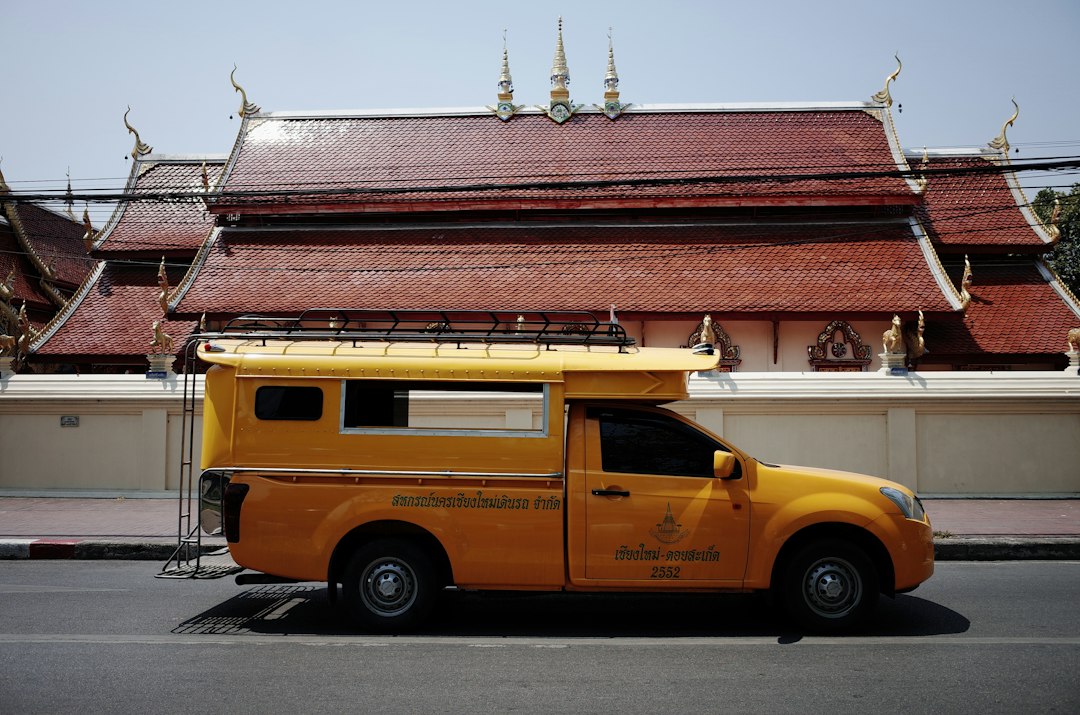
The songthaew (สองแถว, pronounced song-tae-ow, meaning “two rows”) is the most practical way to get around Chiang Mai and dozens of other Thai cities and towns. It’s a pickup truck converted into a shared taxi with two bench seats in the back — cheap, flexible, and used by travellers and locals alike. Once you understand how the system works, it’s faster and far cheaper than calling a Grab or flagging a tuk-tuk.
What Is a Songthaew?
A songthaew is a modified pickup truck with a covered bed and two rows of bench seating facing inward. Passengers sit in the back, stepping up through a rear opening. There’s a small bell or buzzer inside to signal the driver when you want to stop.
In Chiang Mai, songthaews are red — so locals call them rot daeng (red cars). In other parts of Thailand, colours vary by route or city: blue in Chiang Rai, yellow and green in Pattaya for different routes, and so on. Chiang Mai’s red songthaews are the best known and serve both local commuters and tourists.
How Songthaews Work in Chiang Mai
Chiang Mai’s red songthaews operate like shared taxis rather than fixed-route buses. You flag one down, tell the driver your destination, and he either takes you directly (if heading that way or no other passengers aboard) or picks up additional passengers along the way.
Within the moat (old city): Most rides are 30–50 THB per person as of 2026. For solo passengers, some drivers will ask for a flat hire rate of 100–150 THB to take you directly without collecting other riders — negotiable if you’re in a group.
To the Night Bazaar, Nimman, and Santitham: 40–60 THB per person is typical for these cross-city routes.
Doi Suthep and the National Park: A shared songthaew to Doi Suthep temple runs from Nimman Road or the moat area for approximately 60–80 THB per person. For guided tours to Doi Suthep and other Chiang Mai highlights, see GetYourGuide’s Chiang Mai listings. The driver waits at the top for a set time (usually 2–3 hours) and brings the group back. Agree the waiting time before you board.
Day trips to Chiang Mai suburbs (Bo Sang, San Kamphaeng): Dedicated songthaew routes serve these craft village corridors east of the city for around 30–40 THB per person.
Fares are per person on shared runs. If you want the truck to yourself — a chartered run — expect to pay 150–250 THB within the city, more for outlying destinations. Always confirm before boarding whether the fare is shared or chartered.
How to Flag One Down
- Stand at the roadside and raise your hand. Any red songthaew will slow down.
- State your destination clearly. The driver will nod (he’s going that way, share fare) or shake his head (wrong direction) or negotiate a charter price.
- Board through the back. Step up into the truck bed and take a seat on either bench.
- Ring the bell to stop. When you’re close to your destination, press the bell or tap the side of the truck. The driver pulls over where safe.
- Pay as you exit. Hand the fare to the driver or assistant at the back as you step off. Exact change preferred — 20s and 50s work well.
Songthaew vs. Tuk-Tuk vs. Grab
| Songthaew | Tuk-Tuk | Grab | |
|---|---|---|---|
| Cost | 30–80 THB/person | 100–200 THB | 80–150 THB |
| Privacy | Shared | Private | Private |
| Bargaining | Some | Always | No |
| Night availability | Limited after 9pm | Good | 24/7 |
| Air-con | No | No | Yes (car) |
The songthaew wins on price for solo travellers and small groups heading in roughly the right direction. Tuk-tuks are faster for short point-to-point hops when you’re in a hurry. Grab is the right call late at night or in rain when comfort matters.
Avoid tuk-tuks that approach you near temples in the morning offering a “city tour for 20 THB” — these are gem shop scams and a well-documented tourist trap in Chiang Mai.
Songthaews Beyond Chiang Mai
Chiang Rai: Blue songthaews operate fixed local routes within the city for 15–25 THB. Useful for the Night Bazaar and the clock tower area.
Pai: Songthaews run between the town and the bus terminal, and serve outlying hot springs and waterfalls as chartered runs.
Kanchanaburi: Songthaews connect the town centre to the Death Railway Bridge and Erawan National Park — the most practical transport option for both.
Koh Samui and other islands: Songthaews serve as the main shared transport on several islands, running between beaches and the ferry piers. Fares are higher than the mainland (often 100–200 THB) given captive tourist demand — negotiate.
Practical Tips
- Carry small notes. Drivers rarely have change for 500 THB. Keep a stock of 20s and 50s.
- Speak the destination clearly or show it written in Thai. Google Translate’s Thai output is generally understood.
- The fare is per person on shared runs. Don’t assume chartering because you’re the only passenger — confirm before the driver moves off.
- After dark, songthaews thin out fast. In Chiang Mai, most stop running by 9–10pm. Plan accordingly or use Grab for late journeys.
- Drivers may detour to collect more passengers. This is normal on shared runs and rarely adds more than 10–15 minutes.
The songthaew is one of those transport systems that rewards a small investment of confidence — flag one down, state where you’re going, and you’ll wonder how you ever spent money on tuk-tuks.
If you’re still planning your base in Chiang Mai, compare hotels in Chiang Mai to find the area that works for your itinerary.