Chiang Rai Night Market Tours at a Glance
| Tour | Duration | Price (from) | Group Size | Highlights |
|---|---|---|---|---|
| Chiang Rai Night Market Walking & Food Tour | 3 hrs | from $22 | Small group | Chinatown Night Bazaar, Geard market, hill tribe crafts |
| Chiang Rai Day Tour + Night Market Evening | Full day | from $38 | Small group | White Temple by day, Saturday Walking Street by night |
| Chiang Rai White Temple & Night Market Combo | Full day | from $35 | Small group | Wat Rong Khun + evening markets, hotel pickup |
Browse all Chiang Rai tours → GetYourGuide
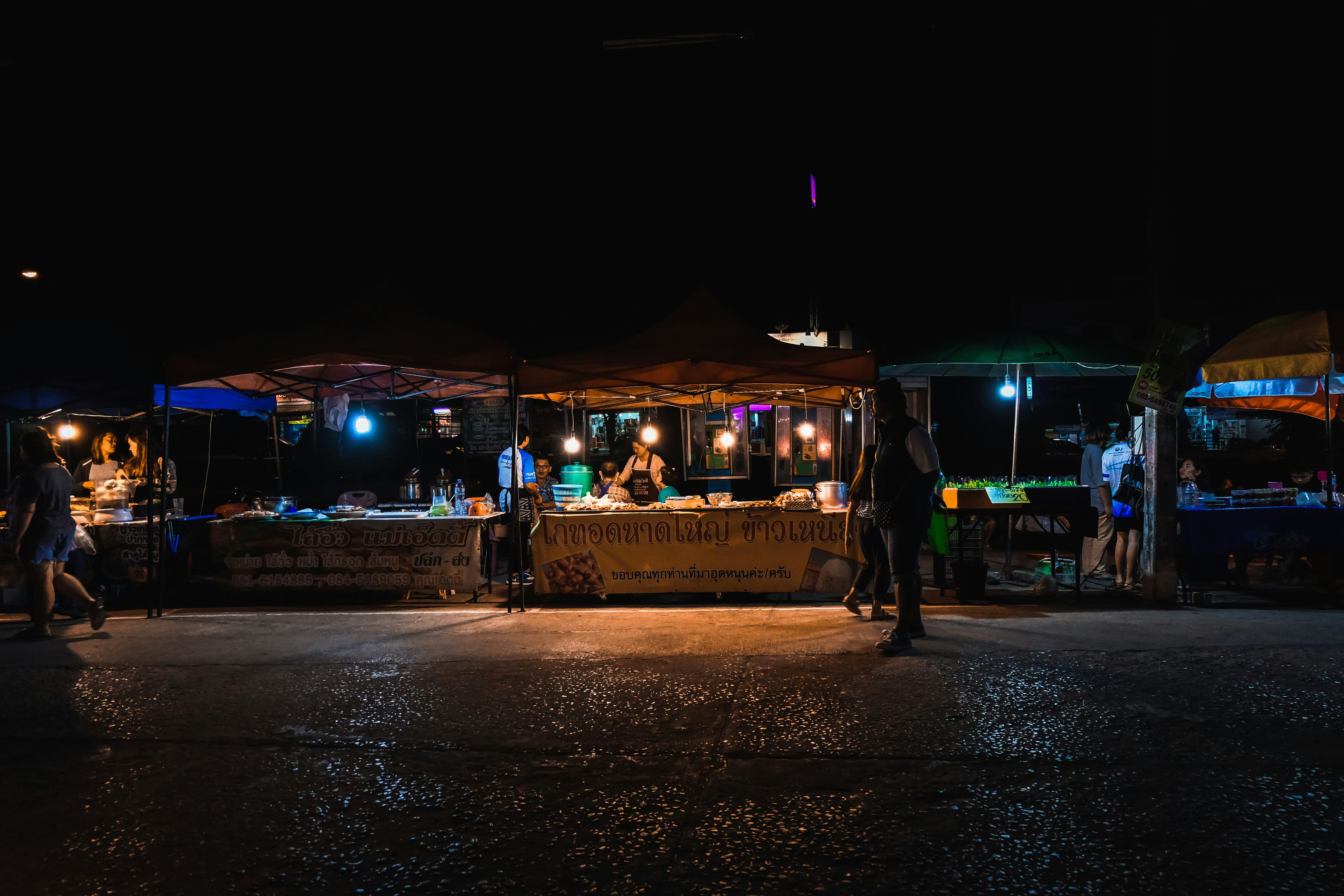
Chiang Rai’s evening market scene is quieter in scale than Chiang Mai’s but more intimate — less built for tourists, more a genuine local gathering. The town has three distinct evening market formats: two weekly walking streets that close roads to traffic, a nightly bazaar near the clock tower, and a network of food vendor clusters that run every evening. The weekly markets are the real draw for anyone spending more than one night in town.
Saturday Walking Street (Thanalai Road)
The most popular market in Chiang Rai. Every Saturday from around 4pm, Thanalai Road (the main road running beside the Night Bazaar complex) closes to vehicles and fills with vendors stretching several hundred metres. The mix leans toward crafts and textiles rather than touristy souvenirs: hand-woven fabrics and embroidered bags from Akha and Karen hilltribe artisans, locally produced tea from the plantation areas north of the city, dried longan and exotic fruits, silverwork and beaded jewellery.
Food stalls run the full length of the market — grilled corn, skewered meats, pad thai, khao soi (northern Thai egg noodle curry), fresh fruit shakes, and sticky rice with mango in season. Prices are low: a full meal of stall food runs ฿80–150 per person.
The market runs until approximately 10pm. Arrive by 5pm for the best selection and before the peak crowd. Parking near the Night Bazaar complex or walk 10 minutes from most central guesthouses.
Sunday Night Market (Sathannee Road Area)
A smaller market operates on Sunday evenings near the clock tower roundabout — sometimes referred to as the Chiang Rai Sunday Night Market. The vendor mix is similar to Saturday but smaller in scope: crafts, second-hand goods, and food stalls clustered along Sathannee Road. From around 5pm until 9pm.
The Sunday market is worth combining with the Golden Clock Tower as a sunset landmark — the tower illuminates with a light show at 7pm, 8pm, and 9pm nightly, and the area around it is animated on Sunday evenings.
The Night Bazaar (Phahonyothin Road)
The permanent Night Bazaar structure on Phahonyothin Road (next to the bus terminal) operates every night of the week. It is the more tourist-facing of Chiang Rai’s markets: larger vendors with fixed prices, souvenir goods alongside crafts, and a covered food court section. The quality is more variable than the walking streets — there is mass-produced goods mixed with genuine hilltribe handicrafts — but it offers the advantage of nightly opening for visitors who miss the weekly events.
The Chinatown Food Court adjacent to the Night Bazaar complex (open from around 5pm) is a practical dinner option with a wide range of Thai-Chinese stalls, including roast duck, dim sum, and noodle soups. Prices ฿60–120 per dish.
Hilltribe Craft Buying Guide
Chiang Rai is one of the better places in northern Thailand to buy genuine hilltribe crafts — the surrounding hills are home to Akha, Karen, Lahu, Hmong, and Yao communities, many of whom sell directly at the walking street markets. A few pointers:
What’s genuine: hand-embroidered cloth, woven baskets, naturally dyed fabrics, and beaded jewellery are commonly made by community members selling at their own stalls. Ask vendors about the origin — most are open about it.
What’s imported: mass-produced items labelled as hilltribe goods (identical bags at every stall, uniformly machine-stitched) are often imported from factories in Chiang Mai or across the border. Prices are a guide: ฿200 for a large embroidered bag is likely factory-made; ฿600–900 may reflect genuine handwork.
Fair prices: the Saturday market has more fixed-price stalls than bargaining culture. Light negotiation (10–20%) is generally acceptable on higher-value items; push too hard and vendors simply decline.
What to Eat at Chiang Rai’s Markets
Khao soi — northern Thailand’s signature dish, unavailable in most other parts of Thailand. Egg noodles in a rich, slightly spicy coconut-based broth with crispy noodle topping, most commonly with chicken or beef. Multiple stalls at Saturday walking street sell it for ฿60–80. Also available year-round at Khao Soi Mae Sai (Sathannee Road, opens 8am).
Sai ua (northern Thai sausage) — herbed pork sausages grilled at stalls throughout the market. Sold by the weight or portion: approximately ฿50–80 for a generous serving. Distinctively fragrant with lemongrass, galangal, and kaffir lime.
Kanom jeen nam ngiao — rice noodles in a Northern Thai tomato-and-pork broth, flavoured with fermented soybean and dried red flowers (dok ngiao). A cheaper and more local eat than khao soi; stalls typically serve it for ฿40–60.
Miang kham — a traditional northern Thai snack: dried shrimp, shallots, ginger, lime, coconut, and chilli wrapped in betel leaves. Stalls at the walking streets sell it pre-assembled for ฿20–40 per portion. Best eaten immediately.
Strawberries — Chiang Rai province is one of Thailand’s main strawberry-growing areas (the cooler northern climate permits it). Fresh strawberries and strawberry juice are available at market stalls during the November–March season, ฿40–60 for a bag.
The Golden Clock Tower
Chiang Rai’s most photographed landmark, designed by Chalermchai Kositpipat (the same artist behind the White Temple), the clock tower is a short walk from the Night Bazaar. A kinetic light show runs at 7pm, 8pm, and 9pm every evening. Entry is free — the surrounding roundabout is a gathering point for locals and visitors in the early evening. Worth combining with dinner in the Night Bazaar area.
After the Market
The area around the Night Bazaar has several bars and live-music venues that open from 9pm. Chinatown Road (running parallel to the main bazaar road) has quieter restaurants and cafes that stay open late. For travellers on an early start for the White Temple, Mae Sai border, or Golden Triangle the following day, most places in the Night Bazaar vicinity close by 10–10:30pm.
See our Chiang Rai things to do guide for the White Temple (Wat Rong Khun), Blue Temple, and the main day trips to the Golden Triangle and Chiang Saen — the markets work well as an evening addition after a full day at the main sights.