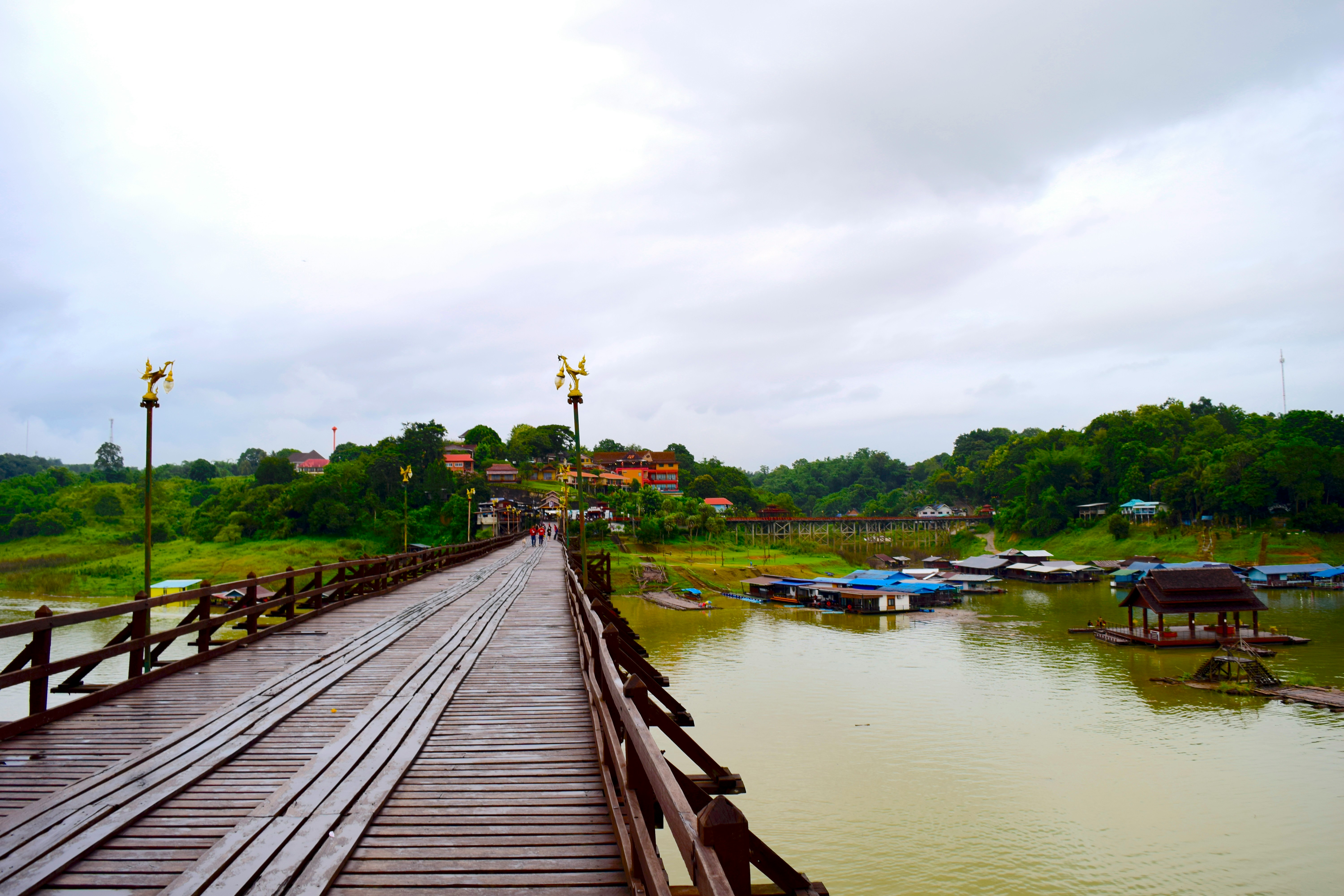
Kanchanaburi sits 130km west of Bangkok in the valley where the Kwai Yai and Kwai Noi rivers meet — a town most people know through the wartime history of the Death Railway and the Bridge on the River Kwai. Beyond the history, the province holds Erawan Falls, one of Thailand’s most beautiful waterfall systems, plus forests, caves, and the Khao Laem reservoir. As a day trip from Bangkok, Kanchanaburi rewards an early departure and disciplined planning; as an overnight stop, it opens up a wider circuit.
Getting to Kanchanaburi from Bangkok
Minivan is the most popular option. Departures from Khao San Road (tourist hub) and Victory Monument throughout the morning — journey time 2.5 to 3 hours depending on traffic, cost around ฿200 each way. Book the day before at guesthouses or travel agents near Khao San Road.
Public bus from Southern Bus Terminal (Sai Tai Mai, accessible by BTS to Mo Chit then taxi): journey 2.5 to 3 hours, approximately ฿120. Buses run frequently until mid-afternoon.
Train from Thonburi Station (not Hua Lamphong or Krung Thep Aphiwat) on the No.257/259 service: 2.5 hours, ฿100 third class. Departure at 7:45am arrives Kanchanaburi around 10:15am. The train route through the rural western suburbs has its own appeal.
Organised tour from Bangkok: typically ฿1,200–1,800 per person including transport, guide, lunch, and main entry fees. Tours depart around 6–7am and return by 7–8pm. The advantage is that they handle the Erawan detour logistics when included. Browse Kanchanaburi day tours from Bangkok on GetYourGuide.
Own transport: If driving or hiring a car with driver, the journey is around 2 hours via Route 4 (Phetkasem Road) from Bangkok. Parking is available near the bridge.
The Bridge on the River Kwai
The original structure was built by Allied prisoners of war and conscripted Asian labourers under the Japanese Imperial Army between 1942 and 1943 — at enormous human cost. The current bridge is largely a postwar reconstruction (the curved spans are original; the square-shaped spans replaced bomb-damaged sections). Walking across the bridge is free and permitted when no train is passing. Trains cross at around 10:30am and 4:30pm — check locally for the current schedule, as timings shift.
The bridge is in the centre of Kanchanaburi town, easy to reach from the bus station.
JEATH War Museum
JEATH stands for Japan, England, Australia, Thailand, and Holland — the principal nationalities involved in the Death Railway construction. The museum is on the riverbank below the bridge, housed in a replica of a bamboo POW hut. Displays cover daily life in the camps: photographs, personal accounts, tools, and artefacts. Entry: ฿40. Open daily 8am–6pm.
A second war museum — the World War II Museum near the bridge — covers some of the same ground and includes a diverse (sometimes eccentrically curated) collection of artefacts. Entry: ฿40.
Kanchanaburi War Cemetery (Don Rak)
The main Allied war cemetery, maintained by the Commonwealth War Graves Commission, holds 6,982 graves — the majority of the Allied prisoners who died during railway construction in this sector. The cemetery is immaculately maintained and is a quiet, dignified site. Entry is free. Open daily 8am–6pm. Located on the main road (Saeng Chuto Road), a short walk from the bridge.
The Death Railway — Hellfire Pass and the Nam Tok Route
The most evocative stretch of the original Death Railway runs north of Kanchanaburi along the Kwai Noi valley. The Death Railway bridge train continues north from Kanchanaburi station to Nam Tok (Sai Yok), passing over wooden trestle viaducts above the river gorge — one of the most scenic rail journeys in Thailand. The Nam Tok train departs Kanchanaburi at approximately 10:30am and 4:30pm; return at 12:55pm and 5:05pm. Third class fare: ฿100.
Hellfire Pass is 80km north of Kanchanaburi town — a rock cutting blasted by hand through solid granite by POW labour, named for the torchlit night shifts that gave it the appearance of hellfire. The Hellfire Pass Memorial Museum (free entry, managed by the Australian government) provides comprehensive historical context. Open daily 9am–4pm, closed Tuesdays. Hellfire Pass requires private transport or a tour — it is not reachable by public bus from Kanchanaburi.
Erawan National Park and Falls
65km north of Kanchanaburi town, Erawan Falls is a seven-tier waterfall system in the national park of the same name. Each tier has a jade-green pool, progressively quieter as you climb. The lower tiers (one to three) are the most visited and have resident fish that nibble dead skin from swimmers’ feet. Tiers five to seven require a harder scramble and are noticeably less crowded.
Entry: ฿300 for foreign visitors (฿20 for Thai nationals). Open 8am–4:30pm. Swimming is permitted in most pools; no sunscreen is allowed (to protect the water quality). Lockers available at the entrance.
Getting there: local buses from Kanchanaburi bus station to the park entrance run approximately hourly, around ฿50 each way. Journey time 1.5 hours. Private songthaew from Kanchanaburi town: approximately ฿400 return.
On a day trip from Bangkok, Erawan is best combined with an early departure (6am from Bangkok) and skipping the town centre museums to prioritise the falls.
Wat Pa Luang Ta Bua (Tiger Temple)
The Tiger Temple — where tigers were once kept as a tourist attraction — no longer operates. After a 2016 raid in which 40 tiger cubs were found dead and hundreds of animals confiscated, the site lost its permits and the tigers were transferred to state wildlife sanctuaries. The temple remains open for general Buddhist worship but the tigers are gone. As of 2026, this is not a worthwhile stop for international visitors.
Where to Eat in Kanchanaburi
Floating restaurants on the Kwai River are a local speciality — meals consumed on platforms built over the water. The Keeree Tara restaurant (Maenam Kwai Road, open from 10am) is one of the better-established options with river views and a broad Thai menu; dishes from ฿120. Riverside guesthouses including Sam’s House and Apple’s Retreat serve food throughout the day and are popular with independent travellers.
The town’s main market (morning market on Pak Phraek Road) has Thai breakfasts and snacks for ฿40–60.
Practical Notes
What to bring: comfortable walking shoes if you plan the Hellfire Pass trail (1.7km return), cash for entry fees and food (ATMs are in the town centre), sunscreen and a hat for Erawan’s exposed upper sections, swimwear if visiting the falls.
Water: heat is significant from March to June — carry at least 1.5 litres.
Best time to go: November to February for comfortable temperatures. Erawan is fullest and most photogenic July to October (rainy season — falls are powerful, pools are greenest). Weekdays are significantly quieter at Erawan than weekends, when it fills with Thai families from Bangkok.
Combining sights: the town centre sights (bridge, cemetery, museums) take 3–4 hours. Erawan adds 4 hours minimum including travel from town. Hellfire Pass adds a full hour plus transit. Choose one focus per day trip.
For a broader look at routes heading west from Bangkok, the Kanchanaburi region connects into the Three Pagodas Pass border crossing toward Myanmar. See our northern Thailand itinerary for multi-day route options.