Bangkok’s size — over 1,500 square kilometres — makes transport planning one of the first things to get right. The good news is the city has a modern, affordable rail network that covers most of the areas tourists need. Once you understand which line goes where, getting around is straightforward.
BTS Skytrain
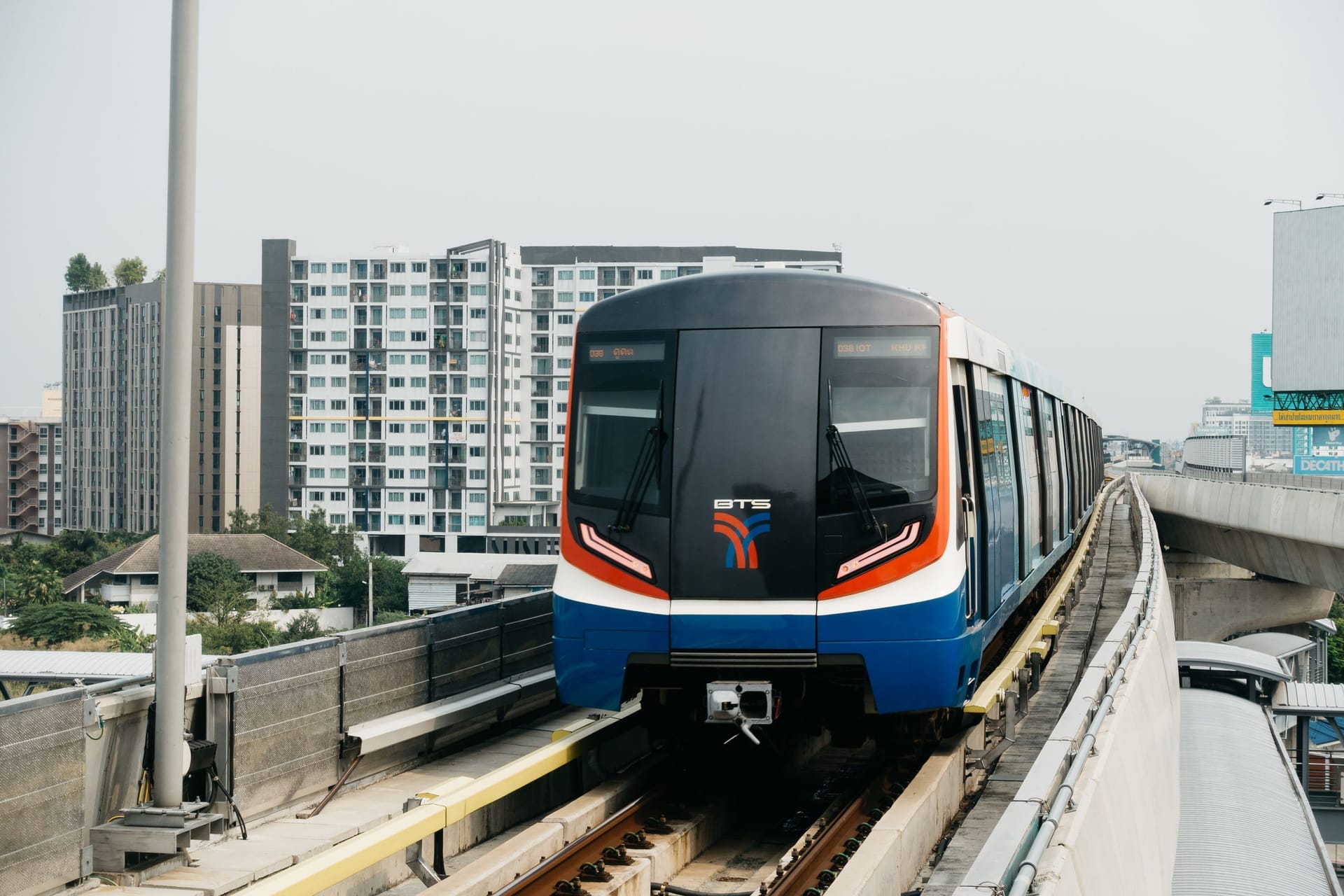
The BTS Skytrain is Bangkok’s elevated rail network and the backbone of city transport for visitors. It runs on two lines:
- Sukhumvit Line (light green): Mo Chit (Chatuchak Market) in the north → Bang Na in the southeast, running the length of Sukhumvit Road through Siam, Asok, and On Nut.
- Silom Line (dark green): National Stadium in the west → Bang Wa in the southwest, passing through Siam, Sala Daeng (for Silom nightlife), and Saphan Taksin (Chao Phraya River piers).
Both lines intersect at Siam station, which functions as the central interchange — most BTS journeys start or pass through here.
Fares: THB 16–59 per trip depending on distance. Trains run approximately 06:00–midnight, every 3–5 minutes during peak hours.
Rabbit Card
The Rabbit card is a stored-value transit card for the BTS. It replaces single-journey tokens, saves time at machines, and can be topped up at any BTS station.
- Cost: THB 100 refundable deposit + minimum THB 100 stored value to activate (THB 200 total upfront)
- Purchase: any BTS staffed counter — bring your passport for the first purchase
- Top-up: any BTS station, minimum THB 100 per top-up
You can buy and pre-load a Bangkok BTS Rabbit Card via Klook before you arrive — useful if you land late and want to get moving without queuing at a machine.
The Rabbit card also works at selected 7-Eleven stores, but its primary value is on the BTS network.
MRT (Metro)
The MRT is Bangkok’s underground rail system, operated separately from the BTS. It runs on three lines:
- Blue Line: the main city loop covering Chatuchak, Huai Khwang, Sukhumvit (interchange with BTS Asok), Silom, and Hua Lamphong (main train station), before looping around through Bang Sue Grand Station (the new central railway hub).
- Purple Line: Bang Yai in Nonthaburi → Tao Poon, connecting the northern suburbs to the Blue Line.
- Yellow Line (automated): Lat Phrao to Samrong, cutting across the eastern city.
Fares: THB 17–42 per trip. Trains run approximately 06:00–midnight.
Payment: MRT Blue Card (stored value), single-journey token, or contactless EMV bank card at newer gates. The Rabbit card does not work on the MRT.
Key MRT stops for visitors: Sukhumvit (interchange with BTS Asok, walking distance to Nana and Terminal 21), Si Lom (interchange with BTS Sala Daeng, entry to Patpong night market), Hua Lamphong (main Hualamphong railway station, Chinatown proximity).
Airport Rail Link (ARL)
The Airport Rail Link connects Suvarnabhumi Airport (BKK) to central Bangkok. It is the fastest and most reliable way between the airport and the city — road traffic from BKK during peak hours can add 30–60 minutes to any taxi or Grab journey.
- City Line: Suvarnabhumi → Phaya Thai (BTS interchange) in 30 minutes, 8 stops, THB 15–45. Trains every 10–15 minutes from 06:00–midnight.
- Express Service: removed permanently in 2021 — only the City Line operates now.
At Phaya Thai, you step off the ARL directly onto the BTS Sukhumvit Line platform. This makes Phaya Thai the single most useful interchange in Bangkok for arriving travellers — one train from the airport, direct connection to Asok, Siam, and the rest of Sukhumvit.
Don Mueang Airport (DMK) is not connected to the ARL. From DMK, the options are: Grab (THB 150–250 to central areas off-peak), public bus, or metered taxi.
Chao Phraya River Boats
The Chao Phraya River runs through central Bangkok and provides a slow but scenic alternative to road and rail for reaching the old city area.
Chao Phraya Express Boat: main river ferry service, stopping at Central Pier (Sathorn/Saphan Taksin, BTS Silom Line terminus), Tha Chang (Grand Palace), Tha Tien (Wat Pho), and Phra Arthit (Khao San Road area). Fares THB 15–40 depending on service flag (orange = tourist express, yellow = limited stops, green = local). Runs approximately 06:00–20:00.
Khlong Saen Saeb Canal Boat: runs east–west through the city along Saen Saeb canal, from Golden Mount (Phan Fa Lilat Pier) to Ramkhamhaeng in the east. Useful for reaching Pratunam and Asok areas from the old city without fighting road traffic. Fare THB 10–20. Runs approximately 05:30–21:00 on weekdays.
The river boats are cheap and atmospheric but not the fastest option — factor in walking time to the piers and the infrequent schedule on quieter routes.
Grab
Grab is the dominant ride-hailing app in Bangkok and the best alternative to the rail network for areas it doesn’t reach — western Bangkok, Don Mueang area, Chatuchak side streets, and anywhere requiring a last-kilometre ride from the nearest BTS/MRT station.
What to expect:
- Fares are shown and locked before you confirm — no metered surprises
- GrabCar (standard sedan): THB 80–200 for most central journeys
- GrabBike (motorcycle): THB 35–80, faster in traffic for solo travellers
- Payment: cash or card in-app; card is faster and avoids the change conversation
Tip for new users: set your destination carefully in the app before requesting. Drivers navigate to a dropped pin, not a street address — pin accuracy matters, especially for hotels in large compounds or sois (side streets).
Grab has effectively replaced flagging down metered taxis for most visitors. Street taxis still operate but meter refusals and unsolicited flat rates are common enough that Grab is the lower-friction choice.
Tuk-tuks and Motorcycle Taxis
Tuk-tuks are the famous three-wheeled open vehicles, negotiated on a flat rate before you get in. They are slower than Grab in traffic, louder, and typically charge more than a metered taxi for comparable distances. They are a Bangkok experience rather than a practical transport option — a short ride for a photo is fine; cross-city reliance is not.
Motorcycle taxis (orange vest drivers at the end of most sois) are the fastest option for the last 500m–2km to/from a BTS or MRT station. Fare is fixed per soi, typically THB 10–20. Useful in heavy traffic; not practical with luggage.
Staying Connected
To use Grab and navigate effectively, a working SIM or eSIM from arrival is useful. An Airalo eSIM for Thailand activates before you land and gives you data immediately on touch-down — no queue at the airport SIM counter.
Tourist SIMs are also available from AIS, DTAC, and TRUE outlets at both airports, 7-Eleven, and BTS stations. A 7-day 30GB SIM typically costs THB 299–399.
Bangkok Transport at a Glance
| Mode | Best for | Typical fare | Speed |
|---|---|---|---|
| BTS Skytrain | Sukhumvit, Silom, Siam | THB 16–59 | Fast |
| MRT | Chinatown, Chatuchak loop, Hua Lamphong | THB 17–42 | Fast |
| Airport Rail Link | Suvarnabhumi → city | THB 15–45 | Fast (30 min) |
| Grab Car | Anywhere off-rail | THB 80–200 | Medium |
| Chao Phraya Boat | Old city, Grand Palace area | THB 15–40 | Slow |
| Tuk-tuk | Short tourist rides | THB 100–200 | Slow |
| Motorcycle taxi | Last-mile from station | THB 10–20 | Fast in traffic |
For most first-time visitors staying around Sukhumvit or Silom, the BTS + MRT covers 80% of journeys. Add Grab for anything outside those corridors and a river boat for the Grand Palace area, and you have a complete Bangkok transport setup.