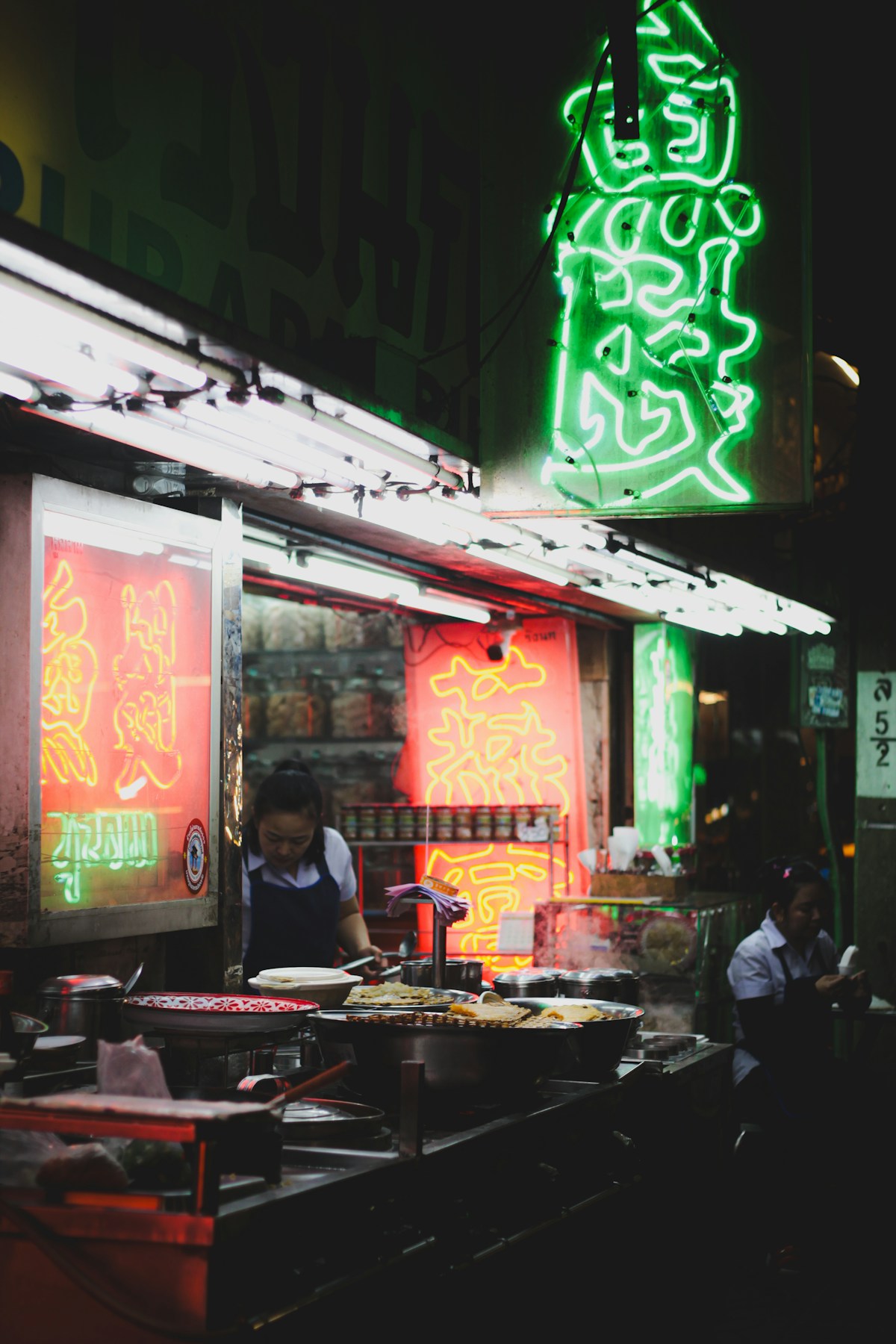
Bangkok is one of the world’s great cities for eating. The range runs from ฿20 bowls of boat noodles to multi-course tasting menus in Michelin-starred restaurants, and nearly all of it is accessible without a reservation or a dress code. Here is how to eat it by area.
Yaowarat: Bangkok’s Chinatown and the benchmark for street food
Yaowarat Road lights up from around 5pm. This is the starting point for Bangkok food — a dense kilometre of roast duck restaurants, seafood stalls, Teochew noodle shops, and Chinese bakeries that have been operating since the early 20th century.
T&K Seafood at the mouth of Phadungdao Road is one of the most photographed stalls — good whole fish, grilled prawns, and seafood rice. Budget approximately ฿200–400 per person. Goes from 5pm until late.
Guay Jub Mr. Joe on Yaowarat Road is the go-to for guay jub — flat rice noodles in a peppery pork-broth soup with crispy pork belly. A bowl is approximately ฿60–80. Simple, excellent, the kind of thing Bangkok does better than anywhere.
Nai Mong Hoi Thod (also known as the famous oyster omelette shop) on Phadungdao Road is the correct address for hoi thod — crispy fried oyster cake. Approximately ฿120–180 per plate. A Chinatown institution since the 1960s.
The Sunday Ratchawat Market (accessible via the canal boat from Tha Chang or BTS to Sanam Chai then cab) is a more local alternative — less touristy than Yaowarat, equally serious about the food.
Victory Monument: boat noodles and office-worker food
Victory Monument BTS is surrounded by one of Bangkok’s most practical food zones — cheap, good, aimed at Thai office workers rather than tourists.
The boat noodle street (Soi 31 area, Phahonyothin Road side) has a dozen small shops selling kuay tiao reua — pork or beef boat noodles in a rich, slightly blood-thickened broth. Bowls are small (฿30–40 each) and you order many. This is one Bangkok food experience that doesn’t translate well to restaurants elsewhere.
Somtam stalls around the Victory Monument roundabout offer Isan food — som tam (papaya salad), larb (minced meat salad), grilled chicken (gai yang), and sticky rice — at genuinely cheap prices (฿50–100 per dish).
Silom and Sathorn: food between business hotels
Silom has the highest concentration of serious Thai restaurants relative to tourist noise. The area is dominated by office workers at lunch and expats in the evening — prices are accordingly honest.
Eat Me Restaurant on Convent Road is one of Bangkok’s better-run creative restaurant — modern international menu with Thai elements, serious wine list. Budget approximately ฿600–1,000 per person. Good for a single occasion dinner.
Somboon Seafood on Convent Road is the most accessible mid-range seafood institution in the area — yellow crab curry (the signature dish), steamed fish with lime and chilli, stir-fried crab claws. Budget approximately ฿400–700 per person.
The Silom Complex food court and the basement food court at MBK (near Siam BTS) are the city’s best value sit-down meals for under ฿100 — clean, air-conditioned, proper Thai food at market prices.
Sukhumvit: international variety and the night market
The Sukhumvit corridor is Bangkok’s most varied eating zone, but also the most expensive and the most variable in quality.
Or Tor Kor Market (next to Chatuchak Weekend Market, Mo Chit BTS) is the city’s benchmark for ingredients and prepared food — the best fruit, the highest-quality street food, decent sit-down restaurants. A morning visit to Or Tor Kor is the reference point for what Thai ingredients look like at their best. Budget approximately ฿150–300 for a market meal.
Thong Lor (Sukhumvit Soi 55) has become Bangkok’s best restaurant street — Japanese, Korean, creative Thai, modern dining, coffee shops. Prices reflect the location (฿400–1,200 per person at most restaurants) but the quality is consistently high.
Ekkamai and Phra Khanong (further east on the BTS line) offer slightly lower prices and a mix of local Thai eating and independent cafe culture that hasn’t yet been fully discovered by food tourism.
Ari and the northern residential zones
Ari BTS area (Phahonyothin Road) has become Bangkok’s best brunch and coffee neighbourhood — lower prices than Thong Lor, a strong mix of independent Thai restaurants, Japanese, and Western cafe fare. Good for a morning or afternoon of eating and sitting.
The Chatuchak Weekend Market food section (Saturday and Sunday only) is one of the city’s best concentrated food experiences — hundreds of stalls selling Thai food, Isan food, fresh coconut ice cream, and grilled everything. Budget ฿100–250 for a full market meal.
Practical information
Hours — Bangkok street food stalls often open from 8am (breakfast), shut around 2pm, then reopen at 5–6pm for the evening. Night markets run until midnight or 1am on most nights.
Getting around — The BTS Skytrain puts Siam, Silom, and Sukhumvit within easy reach. Yaowarat and Rattanakosin require a taxi or MRT (Hua Lamphong or Sam Yot). Grab is reliable throughout.
Budget — Bangkok street food: ฿50–120 per dish. Mid-range restaurants: ฿200–500 per person. Tasting menus and fine dining: ฿1,000–3,000+.
Browse Bangkok food tours and cooking classes
Browse hotels in Bangkok — stay near Silom or Sukhumvit for easy access to the city’s best street food districts and night markets.
See also: Bangkok travel guide · Bangkok things to do · Bangkok floating markets