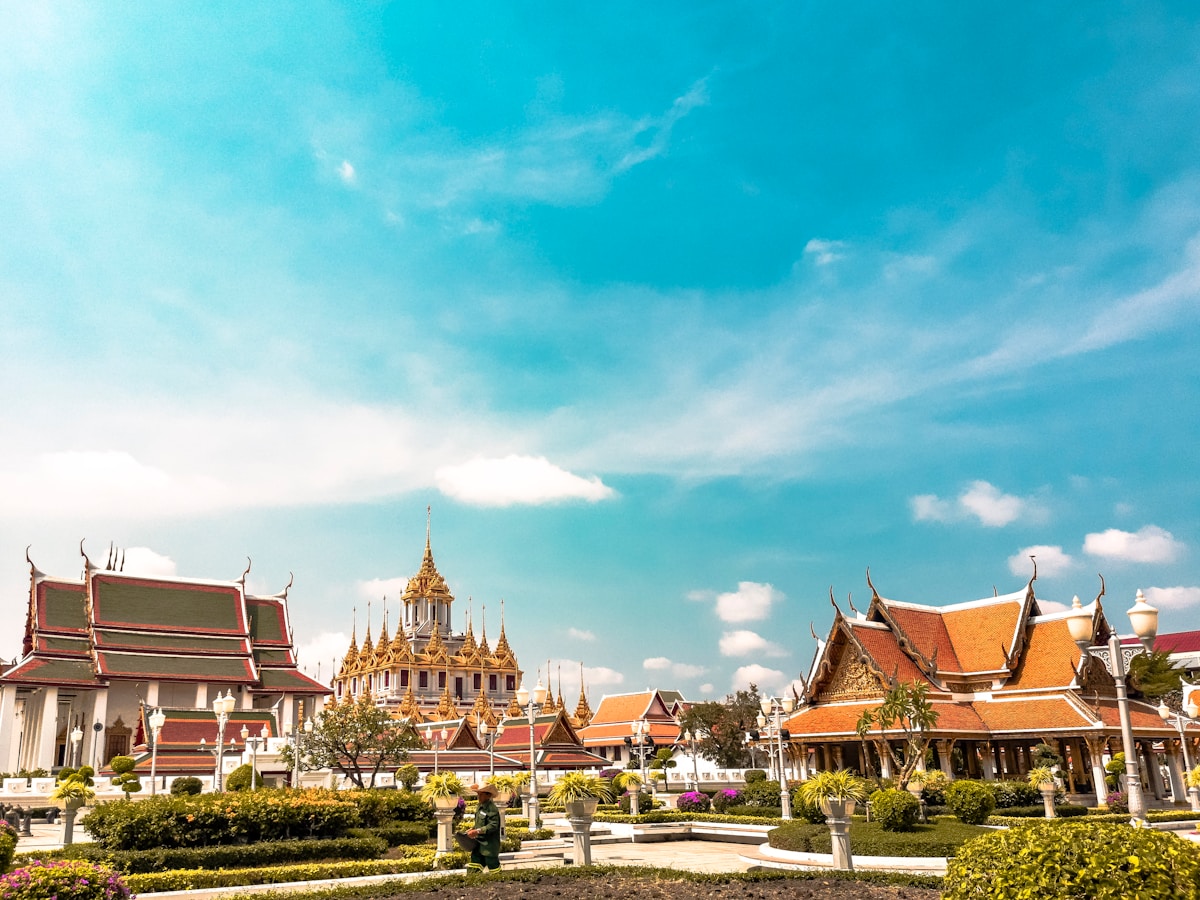
Bangkok’s temple landscape
Bangkok has over 400 Buddhist temples (wats). Most are active places of worship. A practical visitor’s guide needs to be selective: the city’s most significant temples are genuinely worth visiting, but trying to cover them all in a day produces exhaustion rather than understanding. See our full Bangkok guide for neighbourhoods, transport, food, and accommodation.
This guide covers the eight temples most worth your time, organised by significance and proximity, with a suggested itinerary at the end.
Bangkok Temple Tours at a Glance
A good guide adds genuine context to the murals, iconography, and history — hard to pick up from signage alone. These are the top-rated options on GetYourGuide:
| Tour | Duration | Price (from) | Group Size | Highlights |
|---|---|---|---|---|
| Grand Palace, Wat Pho & Wat Arun Sacred & Local Tour | 5 hrs | from ฿750 | Small group | 3 major temples, Flower Market, licensed guide |
| City Highlights Temple & Market Walking Tour | 4 hrs | from ฿900 | Small group | Grand Palace, Wat Phra Kaew, Wat Pho, local transport |
| Sacred Temples & Chinatown Private Guided Tour | 4–5 hrs | from ฿1,400 | Private | Hidden temple lanes, Yaowarat food stops |
| Bangkok Grand Palace Guided Tour | 6–7 hrs | from ฿1,200 | Small group | Full Grand Palace complex, Wat Pho massage option |
Browse all Bangkok temple tours → GetYourGuide
Wat Phra Kaew and the Grand Palace
Entry: ฿500 (covers the entire complex)
Opens: 8:30am daily
Time needed: 2–3 hours
Location: Rattanakosin (Old Town), walkable from the river express boat stop at Tha Chang Pier
The Grand Palace complex is the single most significant historical site in Bangkok. The palace was the official residence of Thai kings from 1782 until the early 20th century. The complex contains multiple buildings, but the central draw for visitors is Wat Phra Kaew - the Temple of the Emerald Buddha.
The Emerald Buddha is small (66cm tall) and made of jade rather than emerald. It sits high on an elaborate throne inside a golden temple interior. The statue’s three seasonal costumes (changed by the King three times a year at the beginning of each season) are solid gold and precious stones. The interior photography is prohibited, which helps preserve the atmosphere.
The murals around the outer gallery of the temple - 178 panels depicting the Ramakien epic - are among the most elaborate in Thai Buddhist art.
Practical notes: The complex opens at 8:30am; being there when the gates open avoids both the heat and the coach groups. The dress code is strictly enforced at the entrance - shoulders and knees covered. Sarongs are loanable at the entrance for free (deposit may be required) or purchasable for ฿100. Tuk-tuk drivers who approach you outside the gates claiming the palace is “closed today for a Buddhist holiday” are operating a scam to redirect you to gem shops - ignore them entirely.
Wat Pho - the Reclining Buddha
Entry: ฿200
Opens: 8:30am daily, closes 6pm
Time needed: 1–1.5 hours
Location: 10-minute walk from the Grand Palace south gate
Wat Pho is Bangkok’s oldest and largest temple complex, predating the city as capital. The Reclining Buddha - 46 metres long and 15 metres high, covered in gold leaf - is one of the most impressive single statues in Thailand. The scale only becomes apparent standing alongside it. The soles of the feet are inlaid with 108 mother-of-pearl designs depicting the 108 auspicious characteristics of the Buddha.
The temple complex extends well beyond the Reclining Buddha hall. Four large chedis in the corners, dozens of smaller statues, and a large courtyard with galleries of seated Buddha images cover the full compound.
Wat Pho is also the traditional home of Thai massage - the temple houses the oldest massage school in Thailand, and the on-site massage parlour is one of the most reputable in the city. A one-hour traditional Thai massage costs ฿420, foot massage ฿380. Booking isn’t required but queues form during midday.
Wat Arun - the Temple of Dawn
Entry: ฿100
Opens: 8:30am daily, closes 5:30pm
Time needed: 45 minutes to 1 hour
Location: West bank of the Chao Phraya; cross from Tha Tien Pier (฿5, 5-minute ferry)
Wat Arun’s central prang (Khmer-style tower) rises 86 metres. The entire tower surface is covered with fragments of Chinese porcelain - plates, cups, and decorative ceramics broken during construction and set into the plaster in intricate patterns. The effect is different from every angle and in different light.
The temple is photogenic from across the river at any time of day, but the late afternoon light (3–5pm) renders the porcelain surface particularly well. The view back across the river to Wat Pho from inside the complex is also worth the trip.
Two smaller prangs can be climbed for views over the river and surrounding area. The stairs are steep.
Getting there: Cross from Tha Tien Pier, directly below Wat Pho, on the river ferry. The crossing runs constantly during daylight hours and costs ฿5. No booking required.
Wat Benchamabophit - the Marble Temple
Entry: Free (฿20 suggested donation)
Opens: 6am daily, closes 6pm
Location: Dusit district, north of the old city. BTS: no direct station - taxi or Grab recommended.
Built in 1899 under Rama V using Italian Carrara marble, Wat Benchamabophit is architecturally distinct from most Bangkok temples. The main chapel is built in a cruciform plan with marble floors, European-style stained glass windows in Thai designs, and a gallery of 52 bronze Buddha images from different periods and countries.
The temple is most striking at dawn when monks leave the complex for alms rounds, returning before 8am. The surrounding canals and formal gardens are quiet in the early morning. This is significantly less visited than the Old Town temples and worth the effort for those who want to see a working temple without crowds.
Wat Saket - the Golden Mount
Entry: ฿20
Opens: 9am daily, closes 5pm
Location: Pom Prap Sattru Phai district. Walk from Khao San Road (15 minutes) or taxi from Old Town.
Wat Saket sits on an artificial hill 58 metres high - constructed under Rama III and completed under Rama IV. The hill was originally intended to be an enormous chedi, but the soft Bangkok soil couldn’t support the weight, and it collapsed into the mound you see today.
The golden chedi at the summit contains a relic of the Buddha. The walk up the spiral path passes trees, bell towers, and inscriptions, with increasingly wide views over Bangkok’s rooftops and temple spires. From the top, the Rattanakosin temples are visible to the southwest.
Less visited than the Big Three, the Golden Mount is a good addition to a day in the Old Town area.
Wat Suthat and the Giant Swing
Entry: ฿20 donation
Opens: 8:30am daily, closes 9pm
Location: Directly opposite the Sao Ching Cha (Giant Swing), near the City Hall
One of Bangkok’s oldest temples (construction began in 1807 under Rama I and took three reigns to complete). The main ordination hall contains a 15th-century Sukhothai bronze Buddha brought from the north by Rama I, considered one of the finest surviving examples of Sukhothai sculpture.
The outer gallery contains 156 additional Buddha statues from China and Java. The murals in the ordination hall are original Rama I-era paintings.
The Giant Swing (Sao Ching Cha) directly outside is not part of the temple but a Brahmanical ritual structure - a 27-metre teak frame used until 1935 for a ceremony where young men swung to great heights to retrieve bags of coins. The ceremony was discontinued after several fatalities.
Wat Traimit - the Golden Buddha
Entry: ฿40
Opens: 9am daily, closes 5pm
Location: Chinatown (Yaowarat), at the junction near Hua Lamphong MRT station
The Golden Buddha - a solid gold seated Buddha statue weighing 5.5 tonnes - is housed in a modern building at the edge of Chinatown. The statue is 3 metres tall and made of 40% pure gold. It was discovered in 1955 when a plaster-covered Buddha being moved by a crane was dropped and revealed the gold beneath - the plaster casing is thought to have been applied to hide it from Burmese invaders in the 18th century.
The statue is undeniably impressive in scale and material. The lower floors of the building contain a decent museum on the history of Bangkok’s Chinatown and the Teochew Chinese community.
Combining with Chinatown: Wat Traimit is a 10-minute walk from the main Yaowarat Road night food strip. Visit the temple in the late afternoon and eat in Chinatown afterwards - our Yaowarat Chinatown food guide covers the best stalls and dishes.
Wat Benchamabophit or Wat Saket - which to choose?
Both are worth visiting. Wat Benchamabophit is quieter, more architecturally distinctive, and better at dawn. Wat Saket has the views and the unusual hill-climb experience. If choosing one, Wat Saket is easier to combine with an Old Town day; Wat Benchamabophit is worth the separate trip if you’re in Bangkok for more than three days.
Dress code across all temples
- Shoulders covered - tank tops and sleeveless shirts are not acceptable at any major temple
- Knees covered - shorts above the knee are refused entry at the Grand Palace complex; at other temples enforcement varies but long shorts are generally acceptable
- Shoes off - always removed before entering any temple building (ubosot or viharn); sandals are easier to manage than lace-up shoes
- Bags - large bags may need to be left at secure counters near entrances to the most formal areas
Half-day or full-day itinerary
Half-day (morning): Wat Phra Kaew and Grand Palace (8:30am, 2–3 hours) → Wat Pho (walk, 1.5 hours) → lunch near Tha Tien pier → done by 1–2pm. Cost: ฿700.
Full day: Wat Phra Kaew (8:30am, 2 hours) → Wat Pho (1.5 hours) → Tha Tien pier ferry to Wat Arun (45 minutes) → lunch on the west bank → return ferry → afternoon rest → Chinatown at night. Cost: ฿800 plus meals.
Add-on: Wat Saket (en route from Old Town to Khao San Road, adds 45 minutes). Wat Traimit (Chinatown, worth combining with an evening food run in Yaowarat).
All three main Old Town temples are within 2km of each other. Walking is possible in the cool hours; Grab or river ferry otherwise. Planning a longer stay? Our 3-day Bangkok itinerary combines the temple circuit with Chinatown, street food, and the best neighbourhoods. You can also book Bangkok temple tours in advance.